An Ending And A Beginning

May 17th, 2009 will be a date that I will always remember. It is the day I attempted to end my own life. My suicide attempt had been preceded by several years of severe depression and anxiety. I had experienced months and months of obsessive suicidal thoughts, and I had absolutely no hope. There is no one thing that caused me to attempt to kill myself, yet at the same time there was one thing that was the final straw.

My depression and anxiety had gotten to a point where I was barely functioning. Day in and day out, my thoughts revolved around the same things, how sad I was, that I was worthless, and my own death. I cried everyday, and I wanted to be alone all the time. I was miserable, and I wanted that miserable feeling to end.

Life got worse. My husband lost his job, and we lost our health insurance. I would no longer be able to afford the many medications I was already taking for diabetes, asthma, and restless leg syndrome. I went to a local, free clinic to find out if they could help me. The clinic was able to give me most of my medications, but they did not have the one I needed for restless leg syndrome. I knew what was going to be in store for me. Months and months of barely any sleep, horrible feelings in my legs, and never being able to be comfortable. As far as I was concerned, this was intolerable, and was the final thing that pushed me to the point of no return.

I did not want to commit suicide with my husband or daughter home. It seemed wrong to me. I did not have to wait long until the right opportunity presented itself. On that day, when everything was in place, I implemented the suicide plan that I had created months before.

The first thing I did was give myself a massive dose of insulin. My reason for doing this was quite simple. When you go into insulin shock, there is a period of time when you feel drunk, eventually you sort of go to sleep or pass out. I figured that if I was in that state or even unconscious then I would not feel the effects of the other medications I was going to take.

After the insulin injection, I started taking my other medications, just a few at a time. I did not want to take all of them at once, in one big dose. I was afraid I would vomit them all up if I did. So with a menu of about ten different medications in front of me, I would take three or four from a bottle and then move on to the next one. I kept repeating this process until my brain was too fuzzy to remember what I was doing. At that point, I just started taking whatever I could, not paying attention to how much I was swallowing down

Whenever I have heard suicide talked about or watched something about it on television, the only thing that was brought up was the person’s thoughts and behavior before the suicide attempt and the results of it. No one seems to want to discuss the middle part, the part when you are dying. I was mentally unprepared for that part. It was painful, confusing and messy.

Despite my best efforts, I began to feel nauseous. My body attempted to vomit a few times, but nothing came up. I could barely walk, and think. I lost control of my bowels. I was agitated. I could not sit down, but I could not walk. It was nothing like I had imagined it would be. Instead of peacefully going to sleep, I was feeling everything that my various overdoses were doing to my body.

Some tiny part of me must have wanted to live, because it was that tiny part that propelled me to call for help. My memory starts getting fuzzy at this point, because I was going in and out of consciousness. From what I was told, when the paramedics arrived at my house, they found me face down on the porch. I have a vague memory of waking up in the ambulance once or twice, and when I arrived at the emergency room. Other than that, I have no memory of anything until the next day.

When I woke up, I felt as if I had cobwebs in my head. I was exhausted and wanted to go back to sleep. It was then that I realized that I was tethered to the bed and there was a guard in my room. My nurse removed the tethers and I went back to sleep and slept for most of the day. It was not until late that afternoon and over the next few days that I found out what had happened while I had been unconscious.

Shortly after the paramedics had gotten me to the hospital, I went into a coma. It was caused by the huge overdose of insulin. During that time, the nurses and doctors worked to bring my blood sugar up and to bring me out of the coma. They also did numerous tests to try and determine what all I had taken. Things were touch and go for a while and I was almost successful in my suicide attempt.

They were able to bring me out of my coma. Unfortunately, I was not in my right mind and became violent. That is why I had been tethered to the bed. I was give several injections of anti-psychotics in hopes that I would calm down. Eventually, they took effect.

The on call psychiatrist came to see me during my time in the intensive care unit. He barely listened to me, nor did he do a proper psychiatric work up. He diagnosed me with Situational Depression and told me that I was to go to a local psychiatric clinic for counseling. Even I knew that what I had was not Situational Depression.

The hospital made an appointment for me at the psychiatric clinic. An intake appointment is what it was called. It was to take place the day after I got out of the hospital. My plan was to not go. Fortunately, my family had other plans and they made me go to the appointment.

I did not want to be there, even though I really needed to be. As the psychologist asked me question after question, it became more and more evident how badly I needed help. It was during this initial visit that the counselor gave me the diagnosis of Clinical Depression. When I left her office that day, the psychologist did not expect me to be back.

I did go back. That tiny part of me that wanted to live, knew that I needed to be there. This was the beginning of my recovery process.

My Mother's Day Present – Mental Health Awareness

As a mother with Clinical Depression and an Anxiety Disorder, I have not always been the parent I should have been. I spent three years in bed, barely able to function, while my daughter had to take care of herself. I traumatized her by attempting to commit suicide and having to be hospitalized. I hurt her when I told her I did not want her around me. By the time I started my recovery process, she was a sad, angry young lady, who no longer trusted me.

Last November my daughter wrote me a letter. In it she expressed how she felt about me, my depression, and how it affected her. With her permission, I wrote a post about her letter. Here is some of her letter and parts of that post:

“I miss the mom I used to have. I miss the mom who would do anything and everything. I miss the mom who would spend time with me. I miss the mom that I could talk to. I miss my fun and loving mom.”

Sadness, hurt, abandonment, tears, and pain are some of the words I think of every time I read that. I feel so sorry for the child who is expressing those feelings. I feel such utter sadness because the child who wrote those words is my daughter.

“I feel like you have pushed me away. I feel like you don’t really mean I Love You.”

I just want to cry when I see those words. I cannot blame her for thinking that though. In my checked out, depressed state I did push people away, including her and my husband. The thought processes going on in my head at the time rationalized me pushing them away. I told myself that by pushing them away, I was getting them used to taking care of themselves. Which meant when I decided the time was right for me to end my life, it would make it easier for me to go through with it.

Since receiving that letter from her, I have worked so hard on our relationship, and I can say that we have made huge progress. She feels comfortable with me and trusts me again. We talk to each other much more than we ever have and we have grown very close. I enjoy my time with her.

Friday afternoon, she came to me and said she could not wait any longer. She gave me two pieces of paper and said “Happy Mother’s Day”. On one piece of paper was a beautiful picture she had drawn. On the other was a letter she had written me. Not only is that letter proof of how much our relationship has changed, it also is the most wonderful gift I have ever been given. With my daughter’s permission I am going to post what she wrote to me.

Mom,
First off, I would like to say Happy Mother’s Day and I hope you like or love the picture, even though it sucks.  You’re the greatest mommy in the world  =) and I think if you were to ask  Minnie, she would bark in agreement.  So I just want to say you are the greatest every day, every month, every year, every hour, that includes the hours that you sleep and snore like a mad woman. =)  So Happy Mother’s Day and I love you a lot…I should be writing letters every day instead of on a day picked out for all moms.

This letter sounds so much more positive than the last one she gave me. In it I can see and feel how much happier she is. Working on our relationship was one of the hardest things I have had to do in my recovery process, but I am so happy that both of us were willing to do what needed to be done. I am looking forward to a lifetime of enjoying her company and loving her.

Saturday Silliness – Mental Health Humor


THE 12 WARNING SIGNS OF GOOD HEALTH*

(If several or more appear, you may rarely need to visit a doctor.)

1. Regular flare-ups of a supportive network of friends and family.
2. Chronic positive expectations.
3. Repeated episodes of gratitude and generosity.
4. Increased appetite for physical activity.
5. Marked tendency to identify and express feelings.
6. Compulsion to contribute to society.
7. Lingering sensitivity to the feelings of others.
8. Habitual behavior related to seeking new challenges.
9. Craving for peak experiences.
10. Tendency to adapt to changing conditions.
11. Feelings of spiritual involvement.
12. Persistent sense of humor.

Mental Hospital Interview

Dr. Leroy, the head psychiatrist at the local mental hospital, is examining patients to see if they’re cured and ready to re-enter society.

“So, Mr. Clark,” the doctor says to one of his patients, “I see by your chart that you’ve been recommended for dismissal. Do you have any idea what you might do once you’re released?”

The patient thinks for a moment, then replies, “Well, I went to school for mechanical engineering. That’s still a good field, good money there. But on the other hand, I thought I might write a book about my experience here in the hospital, what it’s like to be a patient here. People might be interested in reading a book like that. In addition, I thought I might go back to college and study art history, which I’ve grown interested in lately.”

Dr. Leroy nods and says, “Yes, those all sound like intriguing possibilities.”

The patient replies, “And the best part is, in my spare time, I can go on being a teapot.”

Humor And Mental Health – Mental Health Awareness

I have never considered myself a funny person. It is hard to be funny when all you see is the negative in everything. When I started feeling better and my thoughts were more clear and positive, I had to teach myself how to find the humor in life. The way I put it one time, was that my funny bone was broken and needed to be fixed.

Eventually, I learned that I do have a sense of humor. It was just a little squashed from not having been used for so long. Once I began using my sense of humor, I found it a great way to diffuse my emotions when I am angry or irritated. It has also been a great tool in taking the seriousness out of a situation, so I do not worry and stress about things as much. The most important thing I discovered about having a sense of humor, is that it is a great way to bond with the people in your life.

Humor and Mental Health

Laughter is a powerful antidote to stress, pain and conflict. Nothing works faster to bring your mind back into balance than a good laugh.  Humor lightens your load, inspires hope, connects you to others and keeps you grounded focused and alert.  With its ability to heal and renew us, laughter is a wonderful resource for overcoming problems, enhancing relationships, and supporting both physical and mental health.

More than just a break from sadness and pain, laughter gives you the courage and strength to find new sources of meaning and hope.  Even in the most difficult times something as simple as a smile can go a long way to making us feel better.

The Link Between Laughter and Mental Health

  • Laughter dissolves distressing emotions. You cannot feel anxious, angry or sad if you are laughing.
  • Laughter helps you relax and recharge. It reduces stress and increases energy, enabling you to stay focused and accomplish more.
  • Humor shifts perspective, allowing you to see situations in a more realistic, less threatening light.  A humorous perspective creates psychological distance, which can help you avoid feeling overwhelmed

2010 Cartoon-A-Thon

This week I discovered what I think is a terrific site.  It is Mental Health Humor by Chato B. Stewart.

For the last three years in May, Mr. Stewart has hosted a Cartoon-A-Thon for Mental Health Awareness Month. This year his theme is Mental Health Heroes. Each day in May, he will highlight a Mental Health Hero by drawing a caricature of them.

Here is just a tiny bit of his story in his own words.

“I started out with my personal hero… ME!  When I look back just 3 years ago, I was lost; had no hope and in the hospital from a suicide attempt.  It was my last call for help. O.K., maybe I called a few other times in the past… As my Med manager says, it was “multiple attempts.”  This time my cries for help were heard by a piece of paper and a dull pencil in the hospital…  The Psych Ward doesn’t let us have sharp pencils.  I guess, they fear, we might poke an eye out or something.  It was there, it all started.  Instead of writing a journal,  I drew cartoons of my mental vacation.  I found focus and balance in drawing. Yes, it was art therapy with cartoons!”


Mental Health Humor
Permission to use by Chato B. Stewart

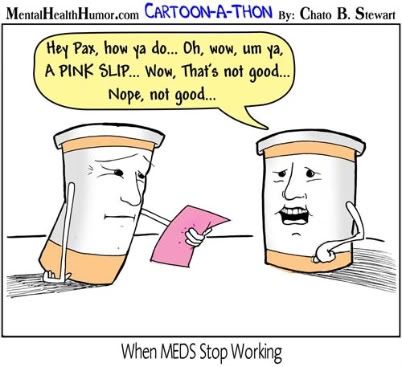
One of the things I like about Mr. Stewart and his humor is his ability to point out the humorous side of what it is like to live with a mental illness. For me, it takes some of the seriousness out of the situation and allows me to see some of what I have encountered in a less discouraging light. I have posted two of his cartoon creations. I encourage you to visit his site and see his other work.


Mental Health Humor
Permission to use by Chato B. Stewart


Mental Health Humor
Permission to use by Chato B. Stewart

The Impact Of Physical Illness On Mental Health – Mental Health Awareness

I believe that my physical illnesses contributed to the poor state of mind I had, as well as developing Clinical Depression, and an Anxiety Disorder. I went from being a relatively healthy person to someone who physically feels rotten much of the time. Also, several of the medications I am on to treat the diabetes and the asthma have been shown to directly affect your brain and lead to depression, especially, if you are already prone to depression or anxiety.  My counselor calls it co-morbidity.


I believe I have a better attitude and outlook about my physical illnesses. When I was in the hospital for my asthma in February,  I was not down in the dumps like I would have been before. Being there on my fortieth birthday did not bother me. I even kept blogging while I was there. I would have the nebulizer in my mouth, for a breathing treatment, and I would be blogging away at the same time. I also think my depression medications help counter how my other medications might affect my brain chemistry.

The Impact of Physical Illness on Mental Health


There is one particular aspect of  mental health that is still not widely discussed.  It is the impact that physical illness has on a person’s mental health.  Mental health workers easily recognize this fact, everyday they see patients with a multitude of physical and mental issues.  Unfortunately, few outside the mental health field see the correlation.

One way to put it in perspective is to think about how you feel when you have a cold.  Obviously, you have a stuffy nose, runny eyes, a fever, and you just feel physically awful.  How about the mental aspect of it?  Many people get cranky, and a bit irritable.   Very often it goes deeper than that.  Many people feel “blue” or “down in the dumps” when they have a cold.  I know I get really whiny when I have a cold.  The good thing is we know that a cold is not going to last very long, most of the time, and soon we will be back to feeling like ourselves.

Now think about this, what if the cold turned into a long term illness?  How do you think that would affect your mental health?  Most people, no matter how mild or serious the illness is, experience a wide range of emotions.  Emotions like anger, sadness, and worry.  We feel like we have no control and that our bodies have let us down.  We feel lonely, and even though there probably have been millions of other people with the same illness, we feel as if no one really understands what we are going through.

From a mental health perspective, when it comes to a chronic or long-term illness, anxiety and depression are the biggest concerns.  Many times these mental health issues  are  over-looked and left untreated.  Which can be very dangerous from both a mental health perspective, it can lead to suicide, and from a physical health perspective, it can delay healing.

Doctors are becoming more aware of how physical illnesses can affect mental health and attempt to be on the look out for the signs and symptoms of anxiety and depression.  However, their best source of information about how you are doing mentally, is from you.  Your doctor will not be aware that you are having any mental health issues if you are not open and honest with them about what is going on in your life and how you are feeling.

Why are depression and anxiety more likely to happen when you have a physical illness?

  • People become depressed and anxious when they are stressed for any reason.  Being ill is stressful.
  • Some drug treatments, such as steroids, affect the way the brain works and can directly cause anxiety and depression.
  • Some physical illness, such as an under-active thyroid, affect the way the brain works and can directly cause anxiety and depression.

You are more likely to experience severe anxiety and depression when you are physically ill if:

  • You have been anxious or depressed before.
  • You do not have family or friends you can talk to about your illness.
  • You are female (women report more anxiety and depression than men).
  • You have other problems or stresses going on in your life at the same time.
  • You are in a lot of pain.
  • Your illness is life threatening.
  • Your illness has left you incapable of taking care of yourself.

Thursday Thirteen – Mental Health Awareness

Since May is Mental Health Awareness Month and many of my posts are about Mental Health Awareness, my thirteen today are thirteen ways to maintain good mental health.

  1. Get enough rest. To have good mental and emotional health, it’s important to take care of your body. That includes getting enough sleep. Most people need seven to eight hours of sleep each night in order to function optimally.
  2. Try to avoid unhealthy mental habits. Repetitive negative mental habits, such as worry and negative thoughts about yourself or the world suck up your time, drain your energy, and trigger feelings of anxiety, fear and depression.  Replace those repetitive negative mental habits with positive ones.
  3. Manage your stress levels. Stress takes a heavy toll on mental and emotional health, so its important to keep it under control.  There is no way to eliminate everything that causes us stress, however, stress management techniques can help bring things more into balance.
  4. Connect with others. We all need to feel valued, supported and connected.  If you feel that your current connections are not enough, you can do a few things to form new ones.  Enroll in a class that intrigues you.  Join a group, like a book club, hiking club, or something else that you find interesting.  Volunteer, working together builds bonds and helping others has its own rewards.  Reach out.  Let people in your life know you need extra time with them.
  5. Get physically active. Dust off your tennis shoes and get your butt moving.  Not only is it good for you body, it is good for your mental health.  It decreases stress, anger and tension.  It reduces anxiety and depression.  It boosts your sense of well being.
  6. Create Joy and Satisfaction. It is time to add a little something to your to do list.  Pencil in a little pleasure.  You probably deserve some joy and pleasure anyway, but there are some serious benefits to pleasure.  Good feelings can help you bounce back from stress, solve problems, improve your thinking, and even boost your immune system.
  7. Eat well. Mom was right, you have to eat well to function well.  Good food can boost your energy, lower the risk of developing certain diseases, and provide fuel for your brain.  It can also counteract the impact of stress on your body, and affect mood-related chemicals in your body.
  8. Take care of your spirit. Spirituality can provide a reassuring belief in a greater force or being, a sense of purpose and meaning, and helps you focus on your own wisdom, and a way to understand suffering.
  9. Deal better with hard times. At some point in our lives, most of us will face times that are extra stressful or that even shake us to our core. At those times, having strong coping strategies can make a huge difference.  People who spend time writing about a difficult event have better health and less depression.  It is also interesting to note, writers doing this often had their grades improves and found writing jobs more quickly.  People facing stress often feel better after problem solving. People who focus on the positive in their lives are less upset by difficult memories.
  10. Help Others. If you lug your elderly neighbor’s groceries up her steps, clearly it’s good for her. But did you know that it’s likely good for you too? Research indicates that those who consistently help other people experience less depression, greater calm, fewer pains and better health. They may even live longer.
  11. Keep things in perspective. Avoid blowing things out of proportion.
  12. Prioritize. Set realistic goals.  Take small steps to accomplish each task, one at a time.
  13. Get professional help if you need it. If the problems in your life are stopping you from functioning well or feeling good, professional help can make a big difference. And if you’re having trouble, know that you are not alone: One in four adults in this country have a mental health problem in any given year.

If you or someone you know is feeling especially bad or suicidal, get help right away. You can call 1-800-273-TALK (8255) to reach a 24-hour crisis center or dial 911 for immediate assistance.

Clinical Depression – Mental Health Awareness

I was diagnosed last year with Clinical Depression. My diagnosis came after several years of suffering, and a suicide attempt. When I compare how I feel now to how I felt this time last year, I am amazed at the difference. Even my soul feels refreshed.
I will always have Clinical Depression, however, my goal is to never allow myself to get that sick with it again. Everyday, I look for any signs that my medications might not be working. I have family members whose job is to watch and see if I exhibit any signs of a set back. I have plans in place in case my medications ever stop working, and I need some extra help for a time. I believe all of these are productive steps in my plan to stay as healthy as I can.

Clinical Depression


Depression affects more people than any other mental illness, more than about 19 million Americans each year.

Clinical Depression is more than just being down in the dumps, or feeling blue.  It is a real illness, and it can be treated.  Unfortunately, most people who have depression do not seek help.

Many people are intimidated by the stigma that surrounds depression or other mental health issues, and as a result do not want to let anyone know they need help.  Others believe depression is just a normal part of  life’s ups and downs, and do not realize that it is a real illness, causing them to delay seeking help, or to never seek it at all.   It is important for people to know that depression is a real illness, and there are many effective treatments for it.

Some signs of depression are:


  • A persistent feeling of sadness, anxiety, or an empty feeling
  • Difficulty falling asleep, staying asleep, or sleeping too much
  • Reduced appetite and weight loss or increased appetite and weight gain
  • Loss of interest and pleasure in once enjoyable activities
  • Restlessness, or irritability
  • Difficulty in concentrating, difficulty in remembering things, or difficulty making decisions
  • Fatigue or loss of energy
  • Feeling guilty, hopeless or worthless
  • Thoughts of suicide or death

If you have been experiencing five or more of these symptoms for two weeks or longer, there is a possibility that you may have depression.  Seek professional help immediately.

If you are a family member is in crisis right now call 1-800-273-TALK or dial 911

Positive Thinking – Mental Health Awareness

Not so long ago, my head was full of negativity. I would tell myself what a loser I was, I was always looking for the worst to happen, and in every situation I could only see the negative. All of that negativity affected my mood, and my attitude.

With the help and encouragement of my counselor, I began to change my thinking. Turning my thoughts to a more positive outlook. In the beginning this was very difficult for me. Months passed with me continuing to try to have more positive thinking. It became easier and easier. I noticed that my mood was improving. I had a more positive attitude about my life. I no longer worried all the time and I was much more relaxed. I became a more pleasant person to be around. I felt better because my thoughts were better.

Positive Thinking


Many people give themselves negative messages.  Most of the time they do not realize they are doing it.  Usually, it is something they learned as a child.  They could have learned these negative messages from other children, teachers, family, caregivers, and society. Once a person has learned them, they tend to repeat them over and over to themselves, especially during a difficult time in life.  They come to believe what the negative messages are saying, and often create their own to add to what they are already repeating to themselves. These negative thoughts or messages lower a person’s self-esteem and make them feel bad about themselves.

Some common messages that people repeat over and over to themselves are “I never do anything right,” “No one likes me,”  “I am a loser,”  “I am stupid.”  Most people believe these messages about themselves, no matter how untrue they are.  The messages tend to point out the worst in a person and they are hard to turn off and unlearn.

However, they can be turned off and replaced with positive messages and thoughts.  To start, you need to pay attention to your thoughts.  Every time you have a negative thought or give yourself a negative message, ask yourself a few questions.  Is this message really true?  Would I say this to another person? If not then why am I  saying it to myself?   What do I  get out of saying this message? If it makes me feel bad then why not stop using it?

Once you are aware of when and what negative thoughts and messages you are saying to yourself you can start replacing them with positive ones.  Since you cannot think two thoughts at the same time, if you are thinking something positive you will not be able to have negative thoughts.  When you are creating your new messages, remember to use positive words like, wonderful, good, smart, loving.

After you have created your new, positive messages, start repeating them to yourself over and over.  Write them over and over if you need to.  Put them in places where you can see them daily, as a reminder to you.  The refrigerator, the bathroom mirror, the door you use to leave your house, as a screen saver on your computer are all good places to put them.

Changing your negative thoughts to positive ones, will take time and persistence.  If you stick with it, in a few weeks you will notice that you have fewer negative thoughts and when they do pop up you will have positive messages to replace them with.  You will also notice that your attitude will change for the better and you will feel physically better as a result of less stress and worry.

Journaling – Mental Health Awareness

I have written before about my own inability to journal, until I started blogging. Once I started, I found that it was extremely helpful in my depression recovery. I have been able to work through many things right here in front of all the world.

My journal/blog has become my best friend.  I can be completely honest with it and it will not judge me.  While I am not suggesting that using a blog as a journal is a good idea for everyone, it has been in my case.  I have some accountability from my regular readers and they also have been a terrific support system.

Even though I did not see the value in journaling when I was younger, I do now. In my opinion, it is not just good for people who have a mental illness, it would also benefit the mentally healthy.

Journaling Can Help Your Mind and Body


Journaling is different than keeping a traditional diary.  Most people use diaries to record daily events and happenings.  Journals are used to record our emotions, reactions, and perceptions of those events.

Keeping a journal is good way to start coping with mental health issues.  It is something you can do by yourself, and it allows you to see your emotions in black and white.  Once your thoughts and feelings are out of your brain and on paper, there is no longer any mystery attached to them.   This allows you to gain some insight about them. Journaling removes mental blocks and lets you use your brain power to better understand yourself, others and the world around you.

Some studies have shown that writing about upsetting personal experiences, for only about twenty minutes, three or four times a week can drastically reduce a person’s blood pressure.  Other studies suggest that journaling can reduce the symptoms of asthma and rheumatoid arthritis.  It is thought that writing about stressful events helps a person come to terms with them, thereby reducing the impact they have on a person’s physical health.

Some benefits of journaling:

Clarifying your thoughts and feelings. When your thoughts and feelings are all jumbled up in your head, take a few minutes to write them down, without any editing. This will help you to quickly get in touch with your internal world.

Getting to know yourself better. By journaling on a routine basis, you will get to know what makes you happy and confident.  It also makes clear which situations and people are toxic for you, important information for your emotional well being.

Reducing stress. Writing about anger, stress, sadness and other painful emotions allows you to release them.  Doing that will help you feel calmer and help you manage your emotions.

Effective problem solving. Writing helps us come up with creative  and unexpected solutions to problems, that on the surface, seem unsolvable.

Finding resolutions to disagreements. Writing about misunderstandings with other people rather than sitting and stewing about them, allows you to see things from their perspective.   This very often leads to a solution that both parties can agree on.

If you are resistant to the idea of keeping a journal, get creative.  Try using a recording device for your journaling, this can include using a web cam.  Blogging is also an effective but fun way to keep a journal.


Anxiety Disorders – Mental Health Awareness

Anxiety is a normal emotion that everyone experiences at times. Many people feel anxious or nervous when there is a problem at work, before taking a test, or making an important decision. Anxiety disorders are different, they are a serious mental illness. People who have an anxiety disorder are often so filled with worry and fear that it has the potential to become crippling.

The causes of anxiety disorders are not fully known. Most experts do agree that it is probably a combination of brain chemistry, environment, life experiences, and hereditary. There are a few risk factors that increase the chance of a person developing an anxiety disorder. Anxiety is more likely to occur if you do not have an outlet for your feelings, especially feelings of anger and frustration. People with low self esteem are at a higher risk. Trauma of some type is a common risk factor. Even a lack of finances can increase a person’s risk of developing an anxiety disorder. A more complete list of risk factors can be found at Panic Survivor

There are five major types of anxiety disorders. It is common for a person to have more than one type of an anxiety disorder. Panic Disorder causes an intense fear that strikes unpredictably, in addition it can also cause heart palpitations, chest pain, and dizziness. Obsessive Compulsive Disorder (OCD) is characterized by recurrent, unwanted thoughts (obsessions) and repetitive behaviors (compulsions). Post Traumatic Stress Disorder (PTSD) can develop after being exposed to a terrifying ordeal, in which serious physical harm occurred or was threatened. Generalized Anxiety Disorder (GAD) is an anxiety disorder that causes a person to have chronic anxiety, and exaggerated worry, even when there is little or nothing to worry about. Social Anxiety Disorder is characterized by an overwhelming anxiety and self consciousness in social situations.

The good news is that all of these anxiety disorders are treatable. There are many different types of treatments available. Each person needs to find what works for them and stick with it. If the appropriate treatment is found and the person follows through with the treatment plan, they can regain some if not all of their ability to function on a day to day basis.

If you believe you or a loved one has an anxiety disorder, please seek help immediately. Family physicians, nurses, religious leaders, mental health specialists, state hospital out patient clinics are some of the places you can go to get help. For a more complete list of places you can get help from go to National Institute of Mental Health

To find a mental health provider in your area you can use the National Mental Health Information Center