An Ending And A Beginning

May 17th, 2009 will be a date that I will always remember. It is the day I attempted to end my own life. My suicide attempt had been preceded by several years of severe depression and anxiety. I had experienced months and months of obsessive suicidal thoughts, and I had absolutely no hope. There is no one thing that caused me to attempt to kill myself, yet at the same time there was one thing that was the final straw.

My depression and anxiety had gotten to a point where I was barely functioning. Day in and day out, my thoughts revolved around the same things, how sad I was, that I was worthless, and my own death. I cried everyday, and I wanted to be alone all the time. I was miserable, and I wanted that miserable feeling to end.

Life got worse. My husband lost his job, and we lost our health insurance. I would no longer be able to afford the many medications I was already taking for diabetes, asthma, and restless leg syndrome. I went to a local, free clinic to find out if they could help me. The clinic was able to give me most of my medications, but they did not have the one I needed for restless leg syndrome. I knew what was going to be in store for me. Months and months of barely any sleep, horrible feelings in my legs, and never being able to be comfortable. As far as I was concerned, this was intolerable, and was the final thing that pushed me to the point of no return.

I did not want to commit suicide with my husband or daughter home. It seemed wrong to me. I did not have to wait long until the right opportunity presented itself. On that day, when everything was in place, I implemented the suicide plan that I had created months before.

The first thing I did was give myself a massive dose of insulin. My reason for doing this was quite simple. When you go into insulin shock, there is a period of time when you feel drunk, eventually you sort of go to sleep or pass out. I figured that if I was in that state or even unconscious then I would not feel the effects of the other medications I was going to take.

After the insulin injection, I started taking my other medications, just a few at a time. I did not want to take all of them at once, in one big dose. I was afraid I would vomit them all up if I did. So with a menu of about ten different medications in front of me, I would take three or four from a bottle and then move on to the next one. I kept repeating this process until my brain was too fuzzy to remember what I was doing. At that point, I just started taking whatever I could, not paying attention to how much I was swallowing down

Whenever I have heard suicide talked about or watched something about it on television, the only thing that was brought up was the person’s thoughts and behavior before the suicide attempt and the results of it. No one seems to want to discuss the middle part, the part when you are dying. I was mentally unprepared for that part. It was painful, confusing and messy.

Despite my best efforts, I began to feel nauseous. My body attempted to vomit a few times, but nothing came up. I could barely walk, and think. I lost control of my bowels. I was agitated. I could not sit down, but I could not walk. It was nothing like I had imagined it would be. Instead of peacefully going to sleep, I was feeling everything that my various overdoses were doing to my body.

Some tiny part of me must have wanted to live, because it was that tiny part that propelled me to call for help. My memory starts getting fuzzy at this point, because I was going in and out of consciousness. From what I was told, when the paramedics arrived at my house, they found me face down on the porch. I have a vague memory of waking up in the ambulance once or twice, and when I arrived at the emergency room. Other than that, I have no memory of anything until the next day.

When I woke up, I felt as if I had cobwebs in my head. I was exhausted and wanted to go back to sleep. It was then that I realized that I was tethered to the bed and there was a guard in my room. My nurse removed the tethers and I went back to sleep and slept for most of the day. It was not until late that afternoon and over the next few days that I found out what had happened while I had been unconscious.

Shortly after the paramedics had gotten me to the hospital, I went into a coma. It was caused by the huge overdose of insulin. During that time, the nurses and doctors worked to bring my blood sugar up and to bring me out of the coma. They also did numerous tests to try and determine what all I had taken. Things were touch and go for a while and I was almost successful in my suicide attempt.

They were able to bring me out of my coma. Unfortunately, I was not in my right mind and became violent. That is why I had been tethered to the bed. I was give several injections of anti-psychotics in hopes that I would calm down. Eventually, they took effect.

The on call psychiatrist came to see me during my time in the intensive care unit. He barely listened to me, nor did he do a proper psychiatric work up. He diagnosed me with Situational Depression and told me that I was to go to a local psychiatric clinic for counseling. Even I knew that what I had was not Situational Depression.

The hospital made an appointment for me at the psychiatric clinic. An intake appointment is what it was called. It was to take place the day after I got out of the hospital. My plan was to not go. Fortunately, my family had other plans and they made me go to the appointment.

I did not want to be there, even though I really needed to be. As the psychologist asked me question after question, it became more and more evident how badly I needed help. It was during this initial visit that the counselor gave me the diagnosis of Clinical Depression. When I left her office that day, the psychologist did not expect me to be back.

I did go back. That tiny part of me that wanted to live, knew that I needed to be there. This was the beginning of my recovery process.

In The Company Of Greatness – Mental Health Awareness Month

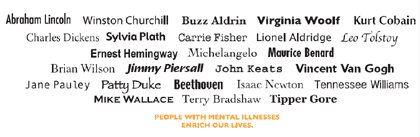
Struggling with a mental illness can make life seem bleak.  It can be inspirational to learn that many of the world’s most famous people have had or currently have a mental illness.  This includes writers, entertainers, artists and political leaders.

  • Isaac Newton – He was the most famous mathematician of the 17th Century, and was responsible for many scientific discoveries we take for granted today. Such as the “corrected” Gregorian calendar date. Newton’s greatest mathematical discovery was the gravitational relationship between the earth and the moon, and of centrifugal force. Newton was well educated, had access to the best knowledge of his day, and was wealthy in later life. In 1705 Newton was the first Scientist to be  knighted by Queen Anne for his great scientific contributions. He suffered from several “nervous breakdowns” in his life and was known for great fits of rage towards anyone who disagreed with him. Some have have said that he had Bipolar Disorder, which was unknown at the time.
  • Linda Hamilton – Best known for her role in “Terminator”, Linda Hamilton  was diagnosed with bipolar late in life, and refers as the years from ages 20 to 40 as “her lost years”. Her rages and mood swings destroyed her marriages and, despite her considerable professional success, she describes her life before treatment as “bleak”.Linda Hamilton’s Interview with Larry King
  • Joe Nash– As a Nobel Prize Winner in mathematics, he has faced a lifelong battle with schizophrenia. He was known as the “Phantom of Fine Hall” at Princeton where his reclusive, ghost like figure could be seen roaming around, leaving messages of his mathematical genus on the boards of empty classrooms. His struggle was well documented in the book “A Beautiful Mind,” by Sylvia Nasar which was later made into a movie by the same name.
  • Ashley Judd – She once spent 47 days in a treatment facility for depression and other emotional problems.  She says
  • “It’s so simple really: I was unhappy and now I’m happy,” she says. “Now, even when I’m having a rough day, it’s better than my best day before treatment.”

  • Brooke Shields – She was diagnosed with Postpartum Depression.  She first had difficulty bonding with her baby and later thought of hurting it and even killing herself. She was able to gain a significant improvement in her mood through medication and the help of a skilled nurse-helper who recognized her problem and encouraged her to get help.

Next week I will highlight more famous people who live or lived with a mental illness.

Parents With Mental Illness – Mental Health Awareness

There is a stigma attached to parents who have a mental illness. This stigma is more severe than for any other chronic illness, like diabetes, heart disease, and cancer. Many people believe that all parents with a mental illness are incapable of being a good parent.  They assume that the children of these parents will be emotionally scarred, abused and neglected.  This is simply not true. Most parents with a mental illness, that is being properly managed,  are no different than parents without a mental illness.

With the wide variety of mental illnesses and symptoms, there will be some parents that find it difficult to be a “good parent”.  However, studies have shown there is an equal percentage of parents without a mental illness that have difficulty with parenting.

Several mental illnesses, depression for example, commonly manifest during a person’s prime parenting years (ages 30 to 44).  This can make us question our own parenting abilities and cause us to worry about whether we are a fit parent or not.  Especially, if we have limited knowledge on what living with a mental illness is like and we have our own mistaken beliefs about the mentally ill.

As parents with a disease, the best thing we can do is get help.  Proper treatment will help us get our symptoms under control, so we can be the best parent we can be.  It will show our children that there is no shame in seeking help for our mental illness.

Here are a few tips to encourage us as we learn to manage our disease and parent at the same time.

  • Recognize the illness and get treatment
  • Recognize that it is possible to have a mental illness and be a “good parent” at the same time.
  • Recognize that staying with your treatment plan is the best way to get better.

Research has shown that “breaking the silence” and discussing a parent’s mental illness, in an age appropriate manner, can help strengthen the family unit and its individual members.  This approach has been found to be helpful in keeping the children resilient and also channeling the worry and self doubt of the parent into more positive outlets.  Like strengthening the parent-child relationship.

Some tips for a parent with a mental illness are:

  • Pay attention to your parenting and make sure your illness does not disrupt your children’s lives.
  • Make sure that your children continue to go to school.
  • Encourage your children’s participation in outside activities (sports, church, and etc.).
  • Encourage their relationships with peers and important adults in their lives (grandparents, uncles, aunts)
  • Make sure your children understand that it is not their fault that their parent is ill and that they are receiving treatment to get better.
  • Be prepared to talk more than once.  It takes families and children time to understand what is going on.  They also may need to be reassured several times that you are getting help and are working hard to get better.

The Benefits Of Having A Mental Illness – Mental Health Awareness

One of the things I had to learn in an effort to manage my Clinical Depression, was to look for the positive in everything. This was so stinking hard in the beginning. It was so outside of my nature that I have had to practice long and hard to see that life does not have to be as serious as I always thought it had to be. With that attitude in mind, I thought I would list thirteen benefits of having a mental illness. If you think of something you would like to see added to the list, put it in the comment section and I will add it.

  1. My life goes according to my schedule most of the time. One of the things that used to stress me out so much was always having to be someplace on time.  Whether it was picking up kids, or getting the grocery shopping done at a decent time, or going on outings, it would all stress me out.  Now that I cannot drive very much because of how sleepy my depression medications make me, someone else is responsible for keeping the schedule  Also because of the sleepiness, I now have a really good reason for why I do not do mornings, and why I need at least one nap a day.
  2. I am much more thankful than I used to be. I have had to learn to rely on other people.  I have had to learn how to say “I need help with something.”  That has made me appreciate the people in my life much more than I used to.
  3. I have a voice! In the past I rarely said what I meant, and meant what I said.  I was always watching what I said, out of fear of angering someone, or offending someone, or even making my needs known above someone else’s.  Now that I have a voice, I say what I mean and I mean what I say.  I am direct and honest with people, and I make my needs known.  I offer my opinions and thoughts.  I still try to not offend people, but I do speak my mind.  It is very liberating to just talk and express myself without the constant worry about who might take what I said the wrong way.
  4. I have made personal connections. When Clinical Depression began to rule my life, I lost my friends.  Most of it was due to my behavior.  I was not a very nice person before my recovery process began.  Since I have been doing better and have been putting myself out into the internet world, I have met so many wonderful people.  They know that I have a mental illness and they do not care about that diagnosis one bit.  Those friendships mean a great deal to me.
  5. No. I remember when my daughter was little and she did not want to listen to the word no.  I had a little song I that I would sing, I believe Lunette the Clown from The Big Comfy Couch was the inspiration behind it.  The words were simple and the tune could be anything you wanted.  It went something like this.  “No means no, means no, means no, means no….”  In the past saying the word no was something I struggled with.  Often that meant I would take on more than I could handle, get over-whelmed and stressed out, and then everything would fall apart.  Now when I find that I am struggling with sticking to my no, I start singing my No song and let people know that I cannot take on anymore than I already have on my plate because I have a mental illness and if I were to get overwhelmed I would very likely have a melt down.
  6. The Mail. I know this is going to sound totally insane, but I used to obsess about the mail.  I was convinced that if anyone other than me checked the mail, then there would be something disastrous in the mailbox.  Once I realized that the mail was a huge source of my anxiety, I chose to no longer get the mail from the mailbox.  Not only do I not have the stress of the mail anymore, but my husband is now in charge of the bills.  Being too anxious to check the mail got rid of two sources of stress at the same time.
  7. I have learned to laugh. I used to be so serious all the time.  Not anymore.  I have learned that laughter feels good.  I laugh at myself, I laugh with others, I laugh when I am all by myself.  I laughed when I re-read what I wrote about my mail box anxiety.
  8. My life is simple. I keep things in my life simple now.  No long exaggerated lists of things to do, clothes to wear, or suppers to cook.  Keeping things simple, frees up my time to do other things.
  9. I take risks. I will take chances now that I never would have before.  I always liked everything very predictable. Nothing could spin me out of control faster than things not going according to my plan.  Having a mental illness has taught me that nothing can really be planned.  Once I start planning, then I start worrying, then I become obsessed with worrying and then….you get the picture.  Now, for the most part, my life does not go according to a plan.   I am stepping out my comfort zone and trying new things, like writing.
  10. I have a better perspective. I have learned to not sweat the little stuff.   Because of my depression, I cannot get bogged down by the little things.  It would be too easy for it to trigger a depressed episode.
  11. I am a better person than I used to be. I had my own very negative ideas about what people with mental illnesses were like.  Now I am one of those people and I have come to realize that people with mental illnesses are not anything like I thought they were.
  12. Helping Others. Being willing to talk about my illness helps others.  It lets them know they are not alone with their thoughts and feelings and there are things that can be done to feel better.
  13. I take better care of myself. I value my life and health much more than I used to.  I spend the time and energy necessary to monitor my other illnesses and do the things I am supposed to in order to manage them.

Sex and Mental Health- Mental Health Awareness Month

Content Warning:  This post contains mature subject matter. This topic may not be suitable for everyone. The topic of sex is discussed. However, it is discussed in a tasteful manner.  It is your decision and sole responsibility if you choose to read past this warning.

I have to admit this is a difficult, and embarrassing topic for me to talk about.  I am just not comfortable discussing sex with anyone but my husband.  However, since I am committed to doing my part in raising awareness about mental health issues, and how to maintain good mental health, I felt that this was an important topic to discuss.

I am just like most adult women in the world, I enjoy sex and I enjoy how it makes me feel.  It makes me feel relaxed and less stressed. It also helps strengthen my relationship with my husband.

Sex and Mental Health

Sex is more than just a moment of pleasure.  Many experts agree that sex has several health benefits, including helping to maintain good mental health.

  • Sex is a great stress reliever. Studies have shown that sex can lower our blood pressure and is a big stress reducer.  Frequent (meaning once or twice a week) intercourse between partners who live together, can lower diastolic blood pressure.
  • Sex improves immunity. Good physical health, means we have a better chance at having good mental health.  Frequent  sexual intercourse can affect our physical health by improving our immune system.  It has been linked with increasing our levels of an antibody called immunoglobulin A, which can protect us from catching colds, other viruses and infections.
  • Think thin. Sex is a great way to burn calories.  It can burn between 75 to 150 per half an hour.
  • Sex improves cardiovascular health. Eating a healthy diet, maintaining good cholesterol levels and watching your sodium intake are all good for the heart, but so is sex.  It raises our heart rate and increases blood flow.  Frequent sexual intercourse can also reduce the risk of a fatal heart attack by half.
  • Sex improves intimacy. Having sex and orgasms increases the levels of a hormone called oxytocin, sometimes referred to as the “love hormone”.  It lets us feel the urge to nurture and to bond.
  • Sex reduces pain. As the levels of oxytocin increases in our bodies so does endorphins.  As the endorphins increase our pain is reduced.  A headache is no longer a valid excuse to not have sex.  It also reduces arthritis pain and PMS symptoms.
  • Sex boosts self esteem. It seems that many people have sex because it makes them feel good about themselves.  If you are in a committed and loving relationship, sex can raise your self esteem.
  • Sex helps you sleep better. Getting enough sleep does wonders in maintaining good mental health and physical health.  The hormone oxytocin that is released during orgasm also helps you sleep.

I would like to thank Dr. Joy Davidson for her advice and encouraging words about my discussing this topic.  She can be found at The Joy Spot

Pets and Mental Health – Mental Health Awareness

I love having a dog. For me, that unconditional love and acceptance I get from them is irreplaceable. Just petting Minnie’s little head, or having her curl up under the covers with me makes me feel good.  I can talk to her and she listens, at least I think she does. She seems to know when I am not feeling well, because she will curl up next to or on me and comfort me.

She keeps my mind busy and occupied because of the care she requires.  Clipping her nails, giving her baths, and throwing toys for her.  I love giving her baths.  She smells so good afterward and the way she runs around like a maniac after I finish bathing her makes me laugh.  I love what she does to get my attention.  When I have my computer in my lap and she has decided that she needs me, she will climb up in my lap and drop her toy on my keyboard.  She never gets mad at me and she is very easy to please. She is a good companion and does a lot in helping me maintain a positive attitude.

Pets and Mental Health

Pets can be good for our mental health.  A pet cannot cure depression or anxiety, nor is it a substitute for medication or talk therapy.  However, a pet can help improve mild to moderate depression in some people, as well as being helpful for people with anxiety disorders and other psychiatric disorders.

Some Benefits of Pet Ownership.

  • Pets can help ease loneliness or isolation. They accept us for who we are and do not judge us.  They also help us stay connected with other people, by providing us with a topic of conversation and by giving us something we have in common with many other people.
  • Physical contact is important to our mental health. Stroking and cuddling with a pet is therapeutic. It relieves stress and anxiety.
  • Animals improve our mood with their companionship. We are also likely to laugh and be more playful when we share our home with a pet.
  • Pet owners are more active. The exercise we get from walking, feeding, and grooming a pet keeps our minds healthy.
  • Routine is beneficial to emotional stability. Caring for a pet provides a predictable routine and a link to reality.

Some things to remember before you rush out and get a pet.

  • If you are already so depressed that you are having difficulty taking care of yourself, having a pet is going to make it worse.
  • If someone is not a “pet person” than getting one is not likely to help improve their life.

However if the conditions are right, pets can help mental health.  The benefits can come from all kinds of pets and not just from dogs and cats.  Even watching fish in an aquarium has been shown to ease muscle tension and lower pulse rates.

My Mother's Day Present – Mental Health Awareness

As a mother with Clinical Depression and an Anxiety Disorder, I have not always been the parent I should have been. I spent three years in bed, barely able to function, while my daughter had to take care of herself. I traumatized her by attempting to commit suicide and having to be hospitalized. I hurt her when I told her I did not want her around me. By the time I started my recovery process, she was a sad, angry young lady, who no longer trusted me.

Last November my daughter wrote me a letter. In it she expressed how she felt about me, my depression, and how it affected her. With her permission, I wrote a post about her letter. Here is some of her letter and parts of that post:

“I miss the mom I used to have. I miss the mom who would do anything and everything. I miss the mom who would spend time with me. I miss the mom that I could talk to. I miss my fun and loving mom.”

Sadness, hurt, abandonment, tears, and pain are some of the words I think of every time I read that. I feel so sorry for the child who is expressing those feelings. I feel such utter sadness because the child who wrote those words is my daughter.

“I feel like you have pushed me away. I feel like you don’t really mean I Love You.”

I just want to cry when I see those words. I cannot blame her for thinking that though. In my checked out, depressed state I did push people away, including her and my husband. The thought processes going on in my head at the time rationalized me pushing them away. I told myself that by pushing them away, I was getting them used to taking care of themselves. Which meant when I decided the time was right for me to end my life, it would make it easier for me to go through with it.

Since receiving that letter from her, I have worked so hard on our relationship, and I can say that we have made huge progress. She feels comfortable with me and trusts me again. We talk to each other much more than we ever have and we have grown very close. I enjoy my time with her.

Friday afternoon, she came to me and said she could not wait any longer. She gave me two pieces of paper and said “Happy Mother’s Day”. On one piece of paper was a beautiful picture she had drawn. On the other was a letter she had written me. Not only is that letter proof of how much our relationship has changed, it also is the most wonderful gift I have ever been given. With my daughter’s permission I am going to post what she wrote to me.

Mom,
First off, I would like to say Happy Mother’s Day and I hope you like or love the picture, even though it sucks.  You’re the greatest mommy in the world  =) and I think if you were to ask  Minnie, she would bark in agreement.  So I just want to say you are the greatest every day, every month, every year, every hour, that includes the hours that you sleep and snore like a mad woman. =)  So Happy Mother’s Day and I love you a lot…I should be writing letters every day instead of on a day picked out for all moms.

This letter sounds so much more positive than the last one she gave me. In it I can see and feel how much happier she is. Working on our relationship was one of the hardest things I have had to do in my recovery process, but I am so happy that both of us were willing to do what needed to be done. I am looking forward to a lifetime of enjoying her company and loving her.

Humor And Mental Health – Mental Health Awareness

I have never considered myself a funny person. It is hard to be funny when all you see is the negative in everything. When I started feeling better and my thoughts were more clear and positive, I had to teach myself how to find the humor in life. The way I put it one time, was that my funny bone was broken and needed to be fixed.

Eventually, I learned that I do have a sense of humor. It was just a little squashed from not having been used for so long. Once I began using my sense of humor, I found it a great way to diffuse my emotions when I am angry or irritated. It has also been a great tool in taking the seriousness out of a situation, so I do not worry and stress about things as much. The most important thing I discovered about having a sense of humor, is that it is a great way to bond with the people in your life.

Humor and Mental Health

Laughter is a powerful antidote to stress, pain and conflict. Nothing works faster to bring your mind back into balance than a good laugh.  Humor lightens your load, inspires hope, connects you to others and keeps you grounded focused and alert.  With its ability to heal and renew us, laughter is a wonderful resource for overcoming problems, enhancing relationships, and supporting both physical and mental health.

More than just a break from sadness and pain, laughter gives you the courage and strength to find new sources of meaning and hope.  Even in the most difficult times something as simple as a smile can go a long way to making us feel better.

The Link Between Laughter and Mental Health

  • Laughter dissolves distressing emotions. You cannot feel anxious, angry or sad if you are laughing.
  • Laughter helps you relax and recharge. It reduces stress and increases energy, enabling you to stay focused and accomplish more.
  • Humor shifts perspective, allowing you to see situations in a more realistic, less threatening light.  A humorous perspective creates psychological distance, which can help you avoid feeling overwhelmed

2010 Cartoon-A-Thon

This week I discovered what I think is a terrific site.  It is Mental Health Humor by Chato B. Stewart.

For the last three years in May, Mr. Stewart has hosted a Cartoon-A-Thon for Mental Health Awareness Month. This year his theme is Mental Health Heroes. Each day in May, he will highlight a Mental Health Hero by drawing a caricature of them.

Here is just a tiny bit of his story in his own words.

“I started out with my personal hero… ME!  When I look back just 3 years ago, I was lost; had no hope and in the hospital from a suicide attempt.  It was my last call for help. O.K., maybe I called a few other times in the past… As my Med manager says, it was “multiple attempts.”  This time my cries for help were heard by a piece of paper and a dull pencil in the hospital…  The Psych Ward doesn’t let us have sharp pencils.  I guess, they fear, we might poke an eye out or something.  It was there, it all started.  Instead of writing a journal,  I drew cartoons of my mental vacation.  I found focus and balance in drawing. Yes, it was art therapy with cartoons!”


Mental Health Humor
Permission to use by Chato B. Stewart

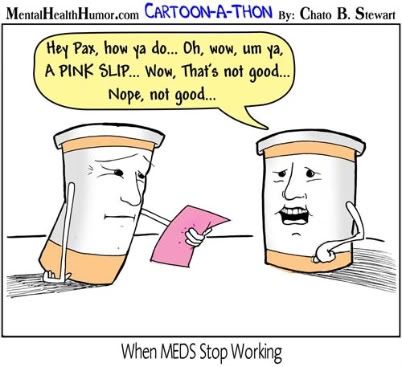
One of the things I like about Mr. Stewart and his humor is his ability to point out the humorous side of what it is like to live with a mental illness. For me, it takes some of the seriousness out of the situation and allows me to see some of what I have encountered in a less discouraging light. I have posted two of his cartoon creations. I encourage you to visit his site and see his other work.


Mental Health Humor
Permission to use by Chato B. Stewart


Mental Health Humor
Permission to use by Chato B. Stewart

The Impact Of Physical Illness On Mental Health – Mental Health Awareness

I believe that my physical illnesses contributed to the poor state of mind I had, as well as developing Clinical Depression, and an Anxiety Disorder. I went from being a relatively healthy person to someone who physically feels rotten much of the time. Also, several of the medications I am on to treat the diabetes and the asthma have been shown to directly affect your brain and lead to depression, especially, if you are already prone to depression or anxiety.  My counselor calls it co-morbidity.

I believe I have a better attitude and outlook about my physical illnesses. When I was in the hospital for my asthma in February,  I was not down in the dumps like I would have been before. Being there on my fortieth birthday did not bother me. I even kept blogging while I was there. I would have the nebulizer in my mouth, for a breathing treatment, and I would be blogging away at the same time. I also think my depression medications help counter how my other medications might affect my brain chemistry.

The Impact of Physical Illness on Mental Health


There is one particular aspect of  mental health that is still not widely discussed.  It is the impact that physical illness has on a person’s mental health.  Mental health workers easily recognize this fact, everyday they see patients with a multitude of physical and mental issues.  Unfortunately, few outside the mental health field see the correlation.

One way to put it in perspective is to think about how you feel when you have a cold.  Obviously, you have a stuffy nose, runny eyes, a fever, and you just feel physically awful.  How about the mental aspect of it?  Many people get cranky, and a bit irritable.   Very often it goes deeper than that.  Many people feel “blue” or “down in the dumps” when they have a cold.  I know I get really whiny when I have a cold.  The good thing is we know that a cold is not going to last very long, most of the time, and soon we will be back to feeling like ourselves.

Now think about this, what if the cold turned into a long term illness?  How do you think that would affect your mental health?  Most people, no matter how mild or serious the illness is, experience a wide range of emotions.  Emotions like anger, sadness, and worry.  We feel like we have no control and that our bodies have let us down.  We feel lonely, and even though there probably have been millions of other people with the same illness, we feel as if no one really understands what we are going through.

From a mental health perspective, when it comes to a chronic or long-term illness, anxiety and depression are the biggest concerns.  Many times these mental health issues  are  over-looked and left untreated.  Which can be very dangerous from both a mental health perspective, it can lead to suicide, and from a physical health perspective, it can delay healing.

Doctors are becoming more aware of how physical illnesses can affect mental health and attempt to be on the look out for the signs and symptoms of anxiety and depression.  However, their best source of information about how you are doing mentally, is from you.  Your doctor will not be aware that you are having any mental health issues if you are not open and honest with them about what is going on in your life and how you are feeling.

Why are depression and anxiety more likely to happen when you have a physical illness?

  • People become depressed and anxious when they are stressed for any reason.  Being ill is stressful.
  • Some drug treatments, such as steroids, affect the way the brain works and can directly cause anxiety and depression.
  • Some physical illness, such as an under-active thyroid, affect the way the brain works and can directly cause anxiety and depression.

You are more likely to experience severe anxiety and depression when you are physically ill if:

  • You have been anxious or depressed before.
  • You do not have family or friends you can talk to about your illness.
  • You are female (women report more anxiety and depression than men).
  • You have other problems or stresses going on in your life at the same time.
  • You are in a lot of pain.
  • Your illness is life threatening.
  • Your illness has left you incapable of taking care of yourself.

Clinical Depression – Mental Health Awareness

I was diagnosed last year with Clinical Depression. My diagnosis came after several years of suffering, and a suicide attempt. When I compare how I feel now to how I felt this time last year, I am amazed at the difference. Even my soul feels refreshed.

I will always have Clinical Depression, however, my goal is to never allow myself to get that sick with it again. Everyday, I look for any signs that my medications might not be working. I have family members whose job is to watch and see if I exhibit any signs of a set back. I have plans in place in case my medications ever stop working, and I need some extra help for a time. I believe all of these are productive steps in my plan to stay as healthy as I can.

Clinical Depression


Depression affects more people than any other mental illness, more than about 19 million Americans each year.

Clinical Depression is more than just being down in the dumps, or feeling blue.  It is a real illness, and it can be treated.  Unfortunately, most people who have depression do not seek help.

Many people are intimidated by the stigma that surrounds depression or other mental health issues, and as a result do not want to let anyone know they need help.  Others believe depression is just a normal part of  life’s ups and downs, and do not realize that it is a real illness, causing them to delay seeking help, or to never seek it at all.   It is important for people to know that depression is a real illness, and there are many effective treatments for it.

Some signs of depression are:


  • A persistent feeling of sadness, anxiety, or an empty feeling
  • Difficulty falling asleep, staying asleep, or sleeping too much
  • Reduced appetite and weight loss or increased appetite and weight gain
  • Loss of interest and pleasure in once enjoyable activities
  • Restlessness, or irritability
  • Difficulty in concentrating, difficulty in remembering things, or difficulty making decisions
  • Fatigue or loss of energy
  • Feeling guilty, hopeless or worthless
  • Thoughts of suicide or death

If you have been experiencing five or more of these symptoms for two weeks or longer, there is a possibility that you may have depression.  Seek professional help immediately.

If you are a family member is in crisis right now call 1-800-273-TALK or dial 911