The End
1

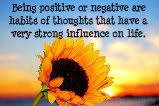 Not so long ago, my head was full of negativity. I would tell myself what a loser I was, I was always looking for the worst to happen, and in every situation I could only see the negative. All of that negativity affected my mood, and my attitude.
With the help and encouragement of my counselor, I began to change my thinking. Turning my thoughts to a more positive outlook. In the beginning this was very difficult for me. Months passed with me continuing to try to have more positive thinking. It became easier and easier. I noticed that my mood was improving. I had a more positive attitude about my life. I no longer worried all the time and I was much more relaxed. I became a more pleasant person to be around. I felt better because my thoughts were better.
Many people give themselves negative messages. Most of the time they do not realize they are doing it. Usually, it is something they learned as a child. They could have learned these negative messages from other children, teachers, family, caregivers, and society. Once a person has learned them, they tend to repeat them over and over to themselves, especially during a difficult time in life. They come to believe what the negative messages are saying, and often create their own to add to what they are already repeating to themselves. These negative thoughts or messages lower a person’s self-esteem and make them feel bad about themselves.
Some common messages that people repeat over and over to themselves are “I never do anything right,” “No one likes me,” “I am a loser,” “I am stupid.” Most people believe these messages about themselves, no matter how untrue they are. The messages tend to point out the worst in a person and they are hard to turn off and unlearn.
However, they can be turned off and replaced with positive messages and thoughts. To start, you need to pay attention to your thoughts. Every time you have a negative thought or give yourself a negative message, ask yourself a few questions. Is this message really true? Would I say this to another person? If not then why am I saying it to myself? What do I get out of saying this message? If it makes me feel bad then why not stop using it?
Once you are aware of when and what negative thoughts and messages you are saying to yourself you can start replacing them with positive ones. Since you cannot think two thoughts at the same time, if you are thinking something positive you will not be able to have negative thoughts. When you are creating your new messages, remember to use positive words like, wonderful, good, smart, loving.
After you have created your new, positive messages, start repeating them to yourself over and over. Write them over and over if you need to. Put them in places where you can see them daily, as a reminder to you. The refrigerator, the bathroom mirror, the door you use to leave your house, as a screen saver on your computer are all good places to put them.
Changing your negative thoughts to positive ones, will take time and persistence. If you stick with it, in a few weeks you will notice that you have fewer negative thoughts and when they do pop up you will have positive messages to replace them with. You will also notice that your attitude will change for the better and you will feel physically better as a result of less stress and worry.

Are you living a truthful life? What does living a truthful life mean anyway? To me, living a truthful life means living an authentic life. It is a life where you are honest with yourself and the others in your life. It is life that follows the old saying of “The Truth Will Set You Free”. Stacy Sheasby of Inspring Joy Today does an excellent job of explaining that old saying.
Living a truthful life is not for the faint of heart. It is difficult, painful, confusing, and joyous all at the same. It requires effort, and internal introspection. It requires a person to be accountable for their own life, without any excuses.
I am attempting to live a truthful life. It is not something I have always attempted to do. In fact the majority of my life has been spent living an untruthful life. I have spent a lot of years lying to myself, lying to others, and just flat out living a lie. The different parts of me were compartmentalized. Part of me shown to this person, another part shown to me, while still yet another part for that group over there. No one, not even me, had access to the whole of me.
In her post, Stacy Sheasby, suggests that if the truth will set us free, then if we are not living a truthful life we are living in a prison. I agree with her. It is a prison of our own making, but never-the-less it is still a prison. My prison took the form of depression, a depression that endured most of my life, becoming more and more severe as I got older. Included in my prison were the Anxiety Guards, and the Panic Attack Warden. If I ever tried to step out of my depression prison cell the Anxiety Guards and the Panic Attack Warden would set off such fears in me that I always scurried back to my “safe” cell.
After many, many years in my self made prison, I grew tired, and hopeless. I chose a way of escaping that gave me an easy way out, one where I did not have to encounter the Anxiety Guards and the Panic Attack Warden. Even that escape did not work. I found myself waking up in a hospital, tethered to a bed and still in my prison.
I was told I had no choice but to begin therapy. I did. I really did not want to, but I did. The smartest move I made in my life was promising myself and others that I would always be truthful in my therapy sessions and with my psychiatrist and actually following through with that promise. So began my journey of attempting to live a truthful life. I could only manage it during those once a week, hour long sessions, but at least it was a beginning.
As time has gone by, and I have gained confidence, began to care about myself, and learned to look at and tell the truth about myself, I have gotten more into the habit of living a truthful life. It is still not easy, I do it more out of habit than actually wanting to do it, but I am attempting, every day, to live a truthful life.
I have experienced a few rewards as a result of my attempting to live a truthful life. My relationships with my family has improved. To think, all these years they have been waiting to hear what was on my mind and for me to set boundaries with them. My depression and anxiety has lessened a great deal. The best reward has been passing the lesson of living a truthful life on to my daughter and her “getting it”.
Anna recently had a accident and broke something of hers that had significant monetary value. She made the decision to not say anything to either me or her father about it. She had decided that since it was an expensive item that we would be mad if she told us. This morning I asked her about that item because I had noticed she had not been using it. She looked like a deer caught in headlights and then she ‘fessed up about the item being broken. I was mad, but I was able to use that as an opportunity to explain to her that there is nothing wrong with being mad, it is a real emotion. It is a truthful emotion. I was also able to use this incident to talk to her about living a truthful life. An hour or so after we had this conversation, she said that she “felt better” because she was no longer worried about being “found out”. She explained the feeling by saying it “felt like an annoying bug that would not go away”.
My hope is that by teaching her to live a truthful life now, she will not find herself locked up in a prison of her own making in the future. There is nothing more beautiful then someone who can live a truthful life from a young age and never has to experience the pain from being in prison for most of their life.
I have ventured more and more outside my depression prison, walking past the Anxiety Guards and Panic Attack Warden. In some ways I am still bound by that prison, but the more attempts I make at living a truthful life, the less hold depression, anxiety and panic attacks have on me. I am looking forward to the day when that prison has absolutely no hold on me.
Are you living a truthful life? Are you living in a prison of your own making? Are you honest with yourself about yourself? Are you honest with others about your thoughts and feelings? Are you honest without excuses? example, I could be happy but…
I am looking forward to seeing how everyone answers those questions.

Suffering from major depression or living with major depression? Is there a difference? Do they mean the same thing?
The definition for suffering is the condition of one who suffers; the bearing of pain or distress.
The definition for living is possessed of or exhibiting life.
From those two definitions alone, there seems to me to be a difference in those two phrases. On a more personal level, I think there is a difference. To me suffering from depression means that the depression is in control of all my thoughts, feelings and life. Living with depression means that I am doing what I can to take control of my depression and not let it be the thing that runs every aspect of my thoughts, feelings and life.
I try very hard when I talk or write about my depression to use the phrase “living with major depression”. If I can say “I am living with major depression” it means that I am being hopeful about my ability to keep heading to a healthier frame of mind. Not to mention major depression is depressing enough, and “living with major depression” just sounds so much more positive than “suffering from”.
I know that this is a game of semantics and in the grand scheme of things for most people, it really would not make a difference which phrased they used. However, for me the phrase I choose to use is a very clear indicator, to me at least, where my mind is at that moment.
I think overall for me the use of positive words is part of my recovery process. It is part of finding the positive in all situations and an attempt at seeing the glass as half full rather than half empty.
Do you think the use of words can influence your state of mind? What positive phrases do you like to use?

Do you have a healthy amount of self respect? If so, have you always. If not, what do you think is holding you back from having it? If you have a healthy amount of self respect, what do you do to maintain it? If you do not, what can you do to try and improve it?


Is it possible to maintain a marriage when one spouse has major depression, especially major depression that lasts for years? The statistics are certainly not encouraging. Marriages with a depressed loved one are nine times more likely to end in divorce. Add this number to the 60% divorce rate we already have, and it seems to me that most marriages where there is a depressed spouse do not survive.
One of the key elements of a marriage is the give and take that is supposed to exist between the married couple. There are times when it is not an equal give and take between the spouses, one having to give more than the other, but ultimately there is always a give and take. This is not the case in a marriage where one of the marriage partners is dealing with a case of long term, major depression.
The spouse without the depression will often find themselves picking up more and more of the slack. Taking care of things that would normally be done by the other spouse. In the short term, this works out OK, however, as the depression drags on and on, and the one spouse is continuing to be stretched thin taking care of things, a certain amount of resentment and frustration starts to build.
The more the depression the goes on the more resentment and frustration build up. I know that my husband expressed to me more than once that he felt like a single parent, when I was at my worst. In addition to feeling like a single parent, there was the added pressure of worrying about me and making sure I was OK.
Accepting that the problem is depression is half the battle for both spouses. It is easy to blame outside sources for why your spouse is in such pain. Before I started getting treatment for my depression my husband felt the sole reason I was acting the way I was, was because of how my son left our home. He did not understand that the depression had been there before that incident, and the incident just made it worse.
Depression affects not only the person with the diagnosis, but it affects the marriage as a whole. Especially if the depression goes untreated. Before my depression was diagnosed and I started the recovery process, my husband thought that I did not love him anymore. From his perspective, I was withdrawn, distant, and did not want to have anything to do with him. He felt hurt and taken advantage of, because I was incapable of helping him around the house. Our marriage was already under strain by the time I started therapy.
Then the things I was learning and doing as a result of the therapy added more stress to our marriage. As far as my husband was concerned the outcome of my therapy was far from what he expected. It has taken him some time to come to grips with the fact that I will not be the person he married.
Both people, not just the one with depression need a support system. It is imperative that even the person without depression has good support to help them through the rough patches. It is also important that both spouses work together on plans and other things that will give both parties guidelines to follow during the recovery process. A support system also can help the married couple identify when thing are not gong a well.
I personally think that it is possible to maintain a marriage when one of the spouses is living with severe depression. However, it is a unique challenge that requires both parties to make the effort to keep the marriage together.
One of the things I used to do was to write contracts with my husband about things I would or would not do. An example is, shortly after I tried to commit suicide, my husband was asked to work out of town. He was hesitant about going because he was afraid that I would try to kill myself again, I was still having suicidal thoughts. We came up with two solutions that made it so he felt like he could work out of town. First, I actually wrote a contract between me and him that stated that I would not try and kill myself during the time he was out of town. Also, knowing how I would isolate myself to attempt suicide, we decided I would stay at my grandmother’s house while he was out of town.
As far as my mine and my husband’s marriage is concerned, things are still a long way from perfect. However, each of us is trying as hard as we can to keep it together. We are also taking more time to understand how my depression has affected us from each other’s point of view.
I try really hard on my bad days to show him affection and tell him I love him, so he does not feel that I do not appreciate all the things he does for me. I can tell he is trying very hard to not become frustrated when I have a bad day and can not be the marriage partner he needs.
I also make a concerted effort to not think about those statistics. I feel like if I pay attention to them too much, then I am allowing them to pigeonhole my marriage into one of the failures. I want to keep my mind on my marriage surviving and thriving.
Thinking about it from the point of view of a depressed person, some of my depression is a result of things that changed who I was when I was a child and as a young adult. Those experiences effected their changes emotionally, and chemically in my brain.
My experiences stuck with me and I was the exact opposite of what I envisioned for myself. My reality did not fit with what I dreamed. In my dreams the person I wanted to be was someone who was full of confidence, and had a positive outlook on life.
My experience with major depression and an anxiety disorder has also left its mark on me as well. Three years of being in a deep, dark depression would leave its mark on anyone. An almost successful suicide attempt, some time in a mental institution, and therapy since May have also changed me.


Confession is good for the soul is what I have been told. I hope it is, because today is my day to confess.
Since Friday my mental health has not been as good has it has been. It is not as bad as it can get, but that is not saying a lot. I have been down, wanting to isolate myself, quiet, and I have not felt like communicating with anyone. I have a counselor’s appointment Thursday so I will be sure to bring it up to her then. I have been faking feeling OK on my blog and with my daughter. However, even over the phone my husband can tell that I am not in a good frame of mind. I even lacked the motivation to take a shower and get dressed for a couple of days.
Some positives are I am not having any suicidal thoughts, and I am not having a negative dialogue running through my head. I mostly feel disengaged from things.
It could be a normal “down” time that everyone goes through, but it is still a struggle for me to identify “normal” emotions as compared to my out of control emotions. That is why running this past the counselor is a good thing, she helps me identify which category my emotions are in.
So that is my confession. I felt compelled to do it because from the beginning of my recovery process I promised I would always tell the truth about what was going on. Sometimes the person I need to tell the truth to the most is myself.


Most of you who are reading this are probably familiar with the children’s book, “The Very Hungry Caterpillar”. At one point I had the whole thing memorized from having read it to my daughter so many times. When she was hungry she would even say she was a hungry caterpillar.
That book came to mind today. I was thinking about how much I have changed in the last few years, and how much more change I have to look forward to. How I am in a transformation process, that I do not know how long it is going to last or what the final outcome outcome might be.
Very much like The Very Hungry Caterpillar, who spends most of his time as a caterpillar preparing for a transformation, and in the transformation process itself, I feel as if I spent most of my life preparing for a transformation, or in the process of transforming. For the first time in my life, I actually feel as if I have grown up.
There was a question in one of the memes I did today that asked if there was anything I could change about my past, what would I change. There was a similar question in a meme I did last week. From what I can tell, it appears that I lot of people have something in their past that they wish they could change. Each time I got that question, I answered it in a similar fashion.
Remember when The Very Hungry Caterpillar had the tummy ache because of eating too much of the wrong things? He learned from that experience. I think if The Very Hungry Caterpillar were asked if he could change anything about his past, he would probably answer “No”. He became a different and slightly better caterpillar because of the tummy ache. There is not one thing I would change about my past. Nothing. It is not as if I have had the most pleasant life, far from it in fact. Some things in my past have caused me pain for years, yet they still help shaped who I am now and who I will be in the future.
Would I be as aware of domestic violence issues, if a former spouse had not broken my nose in a fit of rage? I doubt I would be. If something is not in my frame of reference I tend to not think about it. I know I would not be so aware of major depression, its symptoms, treatments, and long term outlook, if I was not living with it myself. Same with my anxiety disorder, diabetes, and asthma. I know without my childhood experiences, I would have no clue about what it is like to live in an extremely dysfunctional family. Those experiences allow me to empathize with people in similar situations, and maybe even be able to provide them with effective support.
Now that I finally feel like I am a grownup, I can see a few truths about myself. I have used some negative past experiences as excuses for my own negative behaviors. When my major depression was really bad, before I started getting treatment, I used the diabetes and asthma as excuses for why I had no interest in going anywhere, instead of being honest with people. To some extent, I have control over my depression. About a year before I started getting treatment for it, I knew there was something terribly wrong with me. I even knew what it was. I chose not to tell anyone about it. I chose to go ahead with my suicide plans instead of telling anyone that those thoughts were going through my head.
I wonder if The Hungry Caterpillar was afraid when he started his transformation into The Beautiful Butterfly? I know that there have been times when I have been afraid during my own transforming process. I have been afraid because, especially lately, I am changing a great deal. It has caused a shift in my family dynamics. I am most definitely not the same person my husband married. That person went with the flow of things, allowed other people to make decisions for her, and did not stand up for herself. Now, I am all about setting boundaries, standing up for myself, and finding and using my own voice to make decisions and participate fully with things, instead of just going with the flow all the time.
My transformation has been difficult for my husband at times. It has caused some friction in our marriage. There have been times when I have thought we were not going to make it through this process together. What gives me hope that we will make it, is that I see him earnestly trying to keep up with my transformation and working on himself as well.
In my head, I keep seeing myself as a beautiful butterfly. Not on the outside, but on the inside. I will have a beauty inside me that I have never experienced before. I will no longer be filled with negative thoughts, emotions, and actions. Instead, I see my butterfly self as someone who exudes peace, tranquility, and positivity. &
nbsp;