
Humor And Mental Health – Mental Health Awareness

I have never considered myself a funny person. It is hard to be funny when all you see is the negative in everything. When I started feeling better and my thoughts were more clear and positive, I had to teach myself how to find the humor in life. The way I put it one time, was that my funny bone was broken and needed to be fixed.

Eventually, I learned that I do have a sense of humor. It was just a little squashed from not having been used for so long. Once I began using my sense of humor, I found it a great way to diffuse my emotions when I am angry or irritated. It has also been a great tool in taking the seriousness out of a situation, so I do not worry and stress about things as much. The most important thing I discovered about having a sense of humor, is that it is a great way to bond with the people in your life.

Humor and Mental Health

Laughter is a powerful antidote to stress, pain and conflict. Nothing works faster to bring your mind back into balance than a good laugh.  Humor lightens your load, inspires hope, connects you to others and keeps you grounded focused and alert.  With its ability to heal and renew us, laughter is a wonderful resource for overcoming problems, enhancing relationships, and supporting both physical and mental health.

More than just a break from sadness and pain, laughter gives you the courage and strength to find new sources of meaning and hope.  Even in the most difficult times something as simple as a smile can go a long way to making us feel better.

The Link Between Laughter and Mental Health

  • Laughter dissolves distressing emotions. You cannot feel anxious, angry or sad if you are laughing.
  • Laughter helps you relax and recharge. It reduces stress and increases energy, enabling you to stay focused and accomplish more.
  • Humor shifts perspective, allowing you to see situations in a more realistic, less threatening light.  A humorous perspective creates psychological distance, which can help you avoid feeling overwhelmed

2010 Cartoon-A-Thon

This week I discovered what I think is a terrific site.  It is Mental Health Humor by Chato B. Stewart.

For the last three years in May, Mr. Stewart has hosted a Cartoon-A-Thon for Mental Health Awareness Month. This year his theme is Mental Health Heroes. Each day in May, he will highlight a Mental Health Hero by drawing a caricature of them.

Here is just a tiny bit of his story in his own words.

“I started out with my personal hero… ME!  When I look back just 3 years ago, I was lost; had no hope and in the hospital from a suicide attempt.  It was my last call for help. O.K., maybe I called a few other times in the past… As my Med manager says, it was “multiple attempts.”  This time my cries for help were heard by a piece of paper and a dull pencil in the hospital…  The Psych Ward doesn’t let us have sharp pencils.  I guess, they fear, we might poke an eye out or something.  It was there, it all started.  Instead of writing a journal,  I drew cartoons of my mental vacation.  I found focus and balance in drawing. Yes, it was art therapy with cartoons!”


Mental Health Humor
Permission to use by Chato B. Stewart

One of the things I like about Mr. Stewart and his humor is his ability to point out the humorous side of what it is like to live with a mental illness. For me, it takes some of the seriousness out of the situation and allows me to see some of what I have encountered in a less discouraging light. I have posted two of his cartoon creations. I encourage you to visit his site and see his other work.
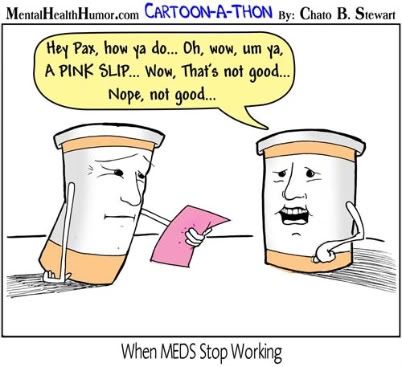

Mental Health Humor
Permission to use by Chato B. Stewart


Mental Health Humor
Permission to use by Chato B. Stewart

The Impact Of Physical Illness On Mental Health – Mental Health Awareness

I believe that my physical illnesses contributed to the poor state of mind I had, as well as developing Clinical Depression, and an Anxiety Disorder. I went from being a relatively healthy person to someone who physically feels rotten much of the time. Also, several of the medications I am on to treat the diabetes and the asthma have been shown to directly affect your brain and lead to depression, especially, if you are already prone to depression or anxiety.  My counselor calls it co-morbidity.


I believe I have a better attitude and outlook about my physical illnesses. When I was in the hospital for my asthma in February,  I was not down in the dumps like I would have been before. Being there on my fortieth birthday did not bother me. I even kept blogging while I was there. I would have the nebulizer in my mouth, for a breathing treatment, and I would be blogging away at the same time. I also think my depression medications help counter how my other medications might affect my brain chemistry.

The Impact of Physical Illness on Mental Health


There is one particular aspect of  mental health that is still not widely discussed.  It is the impact that physical illness has on a person’s mental health.  Mental health workers easily recognize this fact, everyday they see patients with a multitude of physical and mental issues.  Unfortunately, few outside the mental health field see the correlation.

One way to put it in perspective is to think about how you feel when you have a cold.  Obviously, you have a stuffy nose, runny eyes, a fever, and you just feel physically awful.  How about the mental aspect of it?  Many people get cranky, and a bit irritable.   Very often it goes deeper than that.  Many people feel “blue” or “down in the dumps” when they have a cold.  I know I get really whiny when I have a cold.  The good thing is we know that a cold is not going to last very long, most of the time, and soon we will be back to feeling like ourselves.

Now think about this, what if the cold turned into a long term illness?  How do you think that would affect your mental health?  Most people, no matter how mild or serious the illness is, experience a wide range of emotions.  Emotions like anger, sadness, and worry.  We feel like we have no control and that our bodies have let us down.  We feel lonely, and even though there probably have been millions of other people with the same illness, we feel as if no one really understands what we are going through.

From a mental health perspective, when it comes to a chronic or long-term illness, anxiety and depression are the biggest concerns.  Many times these mental health issues  are  over-looked and left untreated.  Which can be very dangerous from both a mental health perspective, it can lead to suicide, and from a physical health perspective, it can delay healing.

Doctors are becoming more aware of how physical illnesses can affect mental health and attempt to be on the look out for the signs and symptoms of anxiety and depression.  However, their best source of information about how you are doing mentally, is from you.  Your doctor will not be aware that you are having any mental health issues if you are not open and honest with them about what is going on in your life and how you are feeling.

Why are depression and anxiety more likely to happen when you have a physical illness?

  • People become depressed and anxious when they are stressed for any reason.  Being ill is stressful.
  • Some drug treatments, such as steroids, affect the way the brain works and can directly cause anxiety and depression.
  • Some physical illness, such as an under-active thyroid, affect the way the brain works and can directly cause anxiety and depression.

You are more likely to experience severe anxiety and depression when you are physically ill if:

  • You have been anxious or depressed before.
  • You do not have family or friends you can talk to about your illness.
  • You are female (women report more anxiety and depression than men).
  • You have other problems or stresses going on in your life at the same time.
  • You are in a lot of pain.
  • Your illness is life threatening.
  • Your illness has left you incapable of taking care of yourself.

Thursday Thirteen – Mental Health Awareness

Since May is Mental Health Awareness Month and many of my posts are about Mental Health Awareness, my thirteen today are thirteen ways to maintain good mental health.

  1. Get enough rest. To have good mental and emotional health, it’s important to take care of your body. That includes getting enough sleep. Most people need seven to eight hours of sleep each night in order to function optimally.
  2. Try to avoid unhealthy mental habits. Repetitive negative mental habits, such as worry and negative thoughts about yourself or the world suck up your time, drain your energy, and trigger feelings of anxiety, fear and depression.  Replace those repetitive negative mental habits with positive ones.
  3. Manage your stress levels. Stress takes a heavy toll on mental and emotional health, so its important to keep it under control.  There is no way to eliminate everything that causes us stress, however, stress management techniques can help bring things more into balance.
  4. Connect with others. We all need to feel valued, supported and connected.  If you feel that your current connections are not enough, you can do a few things to form new ones.  Enroll in a class that intrigues you.  Join a group, like a book club, hiking club, or something else that you find interesting.  Volunteer, working together builds bonds and helping others has its own rewards.  Reach out.  Let people in your life know you need extra time with them.
  5. Get physically active. Dust off your tennis shoes and get your butt moving.  Not only is it good for you body, it is good for your mental health.  It decreases stress, anger and tension.  It reduces anxiety and depression.  It boosts your sense of well being.
  6. Create Joy and Satisfaction. It is time to add a little something to your to do list.  Pencil in a little pleasure.  You probably deserve some joy and pleasure anyway, but there are some serious benefits to pleasure.  Good feelings can help you bounce back from stress, solve problems, improve your thinking, and even boost your immune system.
  7. Eat well. Mom was right, you have to eat well to function well.  Good food can boost your energy, lower the risk of developing certain diseases, and provide fuel for your brain.  It can also counteract the impact of stress on your body, and affect mood-related chemicals in your body.
  8. Take care of your spirit. Spirituality can provide a reassuring belief in a greater force or being, a sense of purpose and meaning, and helps you focus on your own wisdom, and a way to understand suffering.
  9. Deal better with hard times. At some point in our lives, most of us will face times that are extra stressful or that even shake us to our core. At those times, having strong coping strategies can make a huge difference.  People who spend time writing about a difficult event have better health and less depression.  It is also interesting to note, writers doing this often had their grades improves and found writing jobs more quickly.  People facing stress often feel better after problem solving. People who focus on the positive in their lives are less upset by difficult memories.
  10. Help Others. If you lug your elderly neighbor’s groceries up her steps, clearly it’s good for her. But did you know that it’s likely good for you too? Research indicates that those who consistently help other people experience less depression, greater calm, fewer pains and better health. They may even live longer.
  11. Keep things in perspective. Avoid blowing things out of proportion.
  12. Prioritize. Set realistic goals.  Take small steps to accomplish each task, one at a time.
  13. Get professional help if you need it. If the problems in your life are stopping you from functioning well or feeling good, professional help can make a big difference. And if you’re having trouble, know that you are not alone: One in four adults in this country have a mental health problem in any given year.

If you or someone you know is feeling especially bad or suicidal, get help right away. You can call 1-800-273-TALK (8255) to reach a 24-hour crisis center or dial 911 for immediate assistance.

Clinical Depression – Mental Health Awareness

I was diagnosed last year with Clinical Depression. My diagnosis came after several years of suffering, and a suicide attempt. When I compare how I feel now to how I felt this time last year, I am amazed at the difference. Even my soul feels refreshed.
I will always have Clinical Depression, however, my goal is to never allow myself to get that sick with it again. Everyday, I look for any signs that my medications might not be working. I have family members whose job is to watch and see if I exhibit any signs of a set back. I have plans in place in case my medications ever stop working, and I need some extra help for a time. I believe all of these are productive steps in my plan to stay as healthy as I can.

Clinical Depression


Depression affects more people than any other mental illness, more than about 19 million Americans each year.

Clinical Depression is more than just being down in the dumps, or feeling blue.  It is a real illness, and it can be treated.  Unfortunately, most people who have depression do not seek help.

Many people are intimidated by the stigma that surrounds depression or other mental health issues, and as a result do not want to let anyone know they need help.  Others believe depression is just a normal part of  life’s ups and downs, and do not realize that it is a real illness, causing them to delay seeking help, or to never seek it at all.   It is important for people to know that depression is a real illness, and there are many effective treatments for it.

Some signs of depression are:


  • A persistent feeling of sadness, anxiety, or an empty feeling
  • Difficulty falling asleep, staying asleep, or sleeping too much
  • Reduced appetite and weight loss or increased appetite and weight gain
  • Loss of interest and pleasure in once enjoyable activities
  • Restlessness, or irritability
  • Difficulty in concentrating, difficulty in remembering things, or difficulty making decisions
  • Fatigue or loss of energy
  • Feeling guilty, hopeless or worthless
  • Thoughts of suicide or death

If you have been experiencing five or more of these symptoms for two weeks or longer, there is a possibility that you may have depression.  Seek professional help immediately.

If you are a family member is in crisis right now call 1-800-273-TALK or dial 911

Positive Thinking – Mental Health Awareness

Not so long ago, my head was full of negativity. I would tell myself what a loser I was, I was always looking for the worst to happen, and in every situation I could only see the negative. All of that negativity affected my mood, and my attitude.


With the help and encouragement of my counselor, I began to change my thinking. Turning my thoughts to a more positive outlook. In the beginning this was very difficult for me. Months passed with me continuing to try to have more positive thinking. It became easier and easier. I noticed that my mood was improving. I had a more positive attitude about my life. I no longer worried all the time and I was much more relaxed. I became a more pleasant person to be around. I felt better because my thoughts were better.

Positive Thinking


Many people give themselves negative messages.  Most of the time they do not realize they are doing it.  Usually, it is something they learned as a child.  They could have learned these negative messages from other children, teachers, family, caregivers, and society. Once a person has learned them, they tend to repeat them over and over to themselves, especially during a difficult time in life.  They come to believe what the negative messages are saying, and often create their own to add to what they are already repeating to themselves. These negative thoughts or messages lower a person’s self-esteem and make them feel bad about themselves.

Some common messages that people repeat over and over to themselves are “I never do anything right,” “No one likes me,”  “I am a loser,”  “I am stupid.”  Most people believe these messages about themselves, no matter how untrue they are.  The messages tend to point out the worst in a person and they are hard to turn off and unlearn.

However, they can be turned off and replaced with positive messages and thoughts.  To start, you need to pay attention to your thoughts.  Every time you have a negative thought or give yourself a negative message, ask yourself a few questions.  Is this message really true?  Would I say this to another person? If not then why am I  saying it to myself?   What do I  get out of saying this message? If it makes me feel bad then why not stop using it?

Once you are aware of when and what negative thoughts and messages you are saying to yourself you can start replacing them with positive ones.  Since you cannot think two thoughts at the same time, if you are thinking something positive you will not be able to have negative thoughts.  When you are creating your new messages, remember to use positive words like, wonderful, good, smart, loving.

After you have created your new, positive messages, start repeating them to yourself over and over.  Write them over and over if you need to.  Put them in places where you can see them daily, as a reminder to you.  The refrigerator, the bathroom mirror, the door you use to leave your house, as a screen saver on your computer are all good places to put them.

Changing your negative thoughts to positive ones, will take time and persistence.  If you stick with it, in a few weeks you will notice that you have fewer negative thoughts and when they do pop up you will have positive messages to replace them with.  You will also notice that your attitude will change for the better and you will feel physically better as a result of less stress and worry.

The Queen's Meme – Milking Donkeys

The Queen’s Meme #36 ~ The Weird, Unusual and Amusing Meme

Sometimes silly.
Sometimes serious.
Always fun!
Step out of the box.
Be creative.
Use your imagination.
No one’s answers are quite like yours!

The following statements are true. Your job is to explain why you think they are true. Just offer up your usual amusing quips! I’m betting we’ll have some hysterical responses. Remember that somewhere somebody in the world needs to know these things and your tax dollars probably paid for the research that went into proving them true.

1. More people are killed by donkeys annually than are killed in plane crashes.

Maybe people keep trying to milk the donkeys and it makes the donkeys very upset, especially the boy donkeys.

2. Donald Duck comics were banned in Finland because he doesn’t wear pants.

I am not sure why Donald Duck not having pants is that big of a deal.  After all he does not have a dingle that he needs to keep concealed.

3. If you keep a Goldfish in the dark room, it will eventually turn white.

Maybe goldfish use photosynthesis so no light means no color.  Or maybe it is so they can see each other better in the dark.

I know, the skin is made from real gold and when it is dark the gold stealing fairies come and steal the gold fishes gold and it leaves them white.

4. The shortest war in history was between Zanzibar and England in 1896. Zanzibar surrendered after 38 minutes. Why were they fighting in the first place?

They were fighting over a woman

5. Women blink nearly twice as much as men.

That is so we can focus better.

6. The ant always falls over on its right side when intoxicated.

What is the scientific value of finding out which way an ant falls when it is drunk?
Maybe its head is heavier on the right side.

7. An ostrich’s eye is bigger than its brain.

I have no idea why, but it makes sense. When an ostrich sticks its head in the ground it really thinks it is hiding.

8. In England, the Speaker of The House is not allowed to speak.

That is an oxymoron if I have ever heard one. I am clueless. I could google it but then it would take some of the fun out of this meme.

9. By raising your legs slowly and lying on your back, you cannot sink into quicksand.

I have a theory about how this technique was discovered. This is the same position my husband takes when he is farting in bed, so I am thinking the person who discovered that this worked, found out because he was farting.

10. On average, 12 newborns will be given to the wrong parents daily.

Now that is just crazy! Maybe the parents are actually the ones doing it so they can trade their baby in for a better version.

12. The electric chair was invented by a dentist.

Not surprising. The dentist probably invented it as a way to further torture his patients, after all, that is what it feels like when you have to go to the dentist.

Simple Woman's Daybook – May 3, 2010

FOR TODAY May 3, 2010

Outside my window… rain

I am thinking… that May 17th is coming up

I am thankful for… for my husband

From the kitchen… nothing much going on there

I am wearing…
my purple pajamas

I am creating… writing pieces, experimenting with different writing styles

I am going… to see my counselor this week

I am reading…
a lot of information about mental health. May is Mental Health Awareness Month

I am hoping… that I make it through this month mentally intact

I am hearing… birds chirping

Around the house… my daughter is reading, the dog is sleeping, and it is very peaceful

One of my favorite things…
is my writing

A few plans for the rest of the week:
to enter another writing contest, and to get a few blog posts done ahead so they can auto-post

Here is picture for thought I am sharing…

Journaling – Mental Health Awareness

I have written before about my own inability to journal, until I started blogging. Once I started, I found that it was extremely helpful in my depression recovery. I have been able to work through many things right here in front of all the world.

My journal/blog has become my best friend.  I can be completely honest with it and it will not judge me.  While I am not suggesting that using a blog as a journal is a good idea for everyone, it has been in my case.  I have some accountability from my regular readers and they also have been a terrific support system.

Even though I did not see the value in journaling when I was younger, I do now. In my opinion, it is not just good for people who have a mental illness, it would also benefit the mentally healthy.

Journaling Can Help Your Mind and Body


Journaling is different than keeping a traditional diary.  Most people use diaries to record daily events and happenings.  Journals are used to record our emotions, reactions, and perceptions of those events.

Keeping a journal is good way to start coping with mental health issues.  It is something you can do by yourself, and it allows you to see your emotions in black and white.  Once your thoughts and feelings are out of your brain and on paper, there is no longer any mystery attached to them.   This allows you to gain some insight about them. Journaling removes mental blocks and lets you use your brain power to better understand yourself, others and the world around you.

Some studies have shown that writing about upsetting personal experiences, for only about twenty minutes, three or four times a week can drastically reduce a person’s blood pressure.  Other studies suggest that journaling can reduce the symptoms of asthma and rheumatoid arthritis.  It is thought that writing about stressful events helps a person come to terms with them, thereby reducing the impact they have on a person’s physical health.

Some benefits of journaling:

Clarifying your thoughts and feelings. When your thoughts and feelings are all jumbled up in your head, take a few minutes to write them down, without any editing. This will help you to quickly get in touch with your internal world.

Getting to know yourself better. By journaling on a routine basis, you will get to know what makes you happy and confident.  It also makes clear which situations and people are toxic for you, important information for your emotional well being.

Reducing stress. Writing about anger, stress, sadness and other painful emotions allows you to release them.  Doing that will help you feel calmer and help you manage your emotions.

Effective problem solving. Writing helps us come up with creative  and unexpected solutions to problems, that on the surface, seem unsolvable.

Finding resolutions to disagreements. Writing about misunderstandings with other people rather than sitting and stewing about them, allows you to see things from their perspective.   This very often leads to a solution that both parties can agree on.

If you are resistant to the idea of keeping a journal, get creative.  Try using a recording device for your journaling, this can include using a web cam.  Blogging is also an effective but fun way to keep a journal.


Anxiety Disorders – Mental Health Awareness

Anxiety is a normal emotion that everyone experiences at times. Many people feel anxious or nervous when there is a problem at work, before taking a test, or making an important decision. Anxiety disorders are different, they are a serious mental illness. People who have an anxiety disorder are often so filled with worry and fear that it has the potential to become crippling.

The causes of anxiety disorders are not fully known. Most experts do agree that it is probably a combination of brain chemistry, environment, life experiences, and hereditary. There are a few risk factors that increase the chance of a person developing an anxiety disorder. Anxiety is more likely to occur if you do not have an outlet for your feelings, especially feelings of anger and frustration. People with low self esteem are at a higher risk. Trauma of some type is a common risk factor. Even a lack of finances can increase a person’s risk of developing an anxiety disorder. A more complete list of risk factors can be found at Panic Survivor

There are five major types of anxiety disorders. It is common for a person to have more than one type of an anxiety disorder. Panic Disorder causes an intense fear that strikes unpredictably, in addition it can also cause heart palpitations, chest pain, and dizziness. Obsessive Compulsive Disorder (OCD) is characterized by recurrent, unwanted thoughts (obsessions) and repetitive behaviors (compulsions). Post Traumatic Stress Disorder (PTSD) can develop after being exposed to a terrifying ordeal, in which serious physical harm occurred or was threatened. Generalized Anxiety Disorder (GAD) is an anxiety disorder that causes a person to have chronic anxiety, and exaggerated worry, even when there is little or nothing to worry about. Social Anxiety Disorder is characterized by an overwhelming anxiety and self consciousness in social situations.

The good news is that all of these anxiety disorders are treatable. There are many different types of treatments available. Each person needs to find what works for them and stick with it. If the appropriate treatment is found and the person follows through with the treatment plan, they can regain some if not all of their ability to function on a day to day basis.

If you believe you or a loved one has an anxiety disorder, please seek help immediately. Family physicians, nurses, religious leaders, mental health specialists, state hospital out patient clinics are some of the places you can go to get help. For a more complete list of places you can get help from go to National Institute of Mental Health

To find a mental health provider in your area you can use the National Mental Health Information Center

May – Mental Health Awareness Month

May is Mental Health Awareness Month. Professionals, schools, communities, hospitals and media outlets will join together to raise awareness about mental health issues and decrease the stigma that often prevents people from seeking the appropriate help.

To do my part in raising awareness, each day in May, I will post information about mental health issues. You can help me by passing the information on to other people. Together we can reach many people, giving them information, hope, and work towards decreasing the stigma that people have about the mentally ill.