Why Suicide? – Mental Health Awareness

A person who has never had suicidal thoughts, or tendencies has a hard time understanding why someone would want to commit suicide. It is difficult for them to imagine how someone could believe that death is a solution for anything. However, for the suicidal person, death is seen as the ultimate solution.  

Suicide is not a pointless or random act.  To the person committing suicide, it makes perfect sense, and is something they have given a lot of thought to.  It is a solution to an otherwise unsolvable problem.  That problem usually is unrelenting psychological pain.

Generally, when a person reaches the decision to end their own life, they are so full of pain that they want it all to just end.  Their consciousness is full of a never ending stream of distressing thoughts and feelings, with which they are preoccupied.   This stream can contain messages of self-loathing, that they are a burden to their families, guilt, a pervasive sense of hopelessness and other very negative thoughts and emotions.

Because of their skewed thinking, the suicidal person believes the messages that are flooding into their head.  If they could turn them off on their own, they would.  However, they are not able to make use of problem solving strategies, so their internal dialogue continues to be full of negative messages.  This leaves the suicidal person with no way to alleviate their extreme pain.

The only option they see to end their pain is to take their own life.  All their thoughts began to revolve around this idea.  They begin to formulate their suicide plan.  Deciding how they are going to end their life, figuring out when they are going to do it, and where it is going to take place.  It is extreme thinking, with an all or nothing mentality.

A suicidal person cannot think beyond the fact that suicide will provide them an escape from intolerable circumstances, and their pain can end instantly.  They are seeking oblivion and suicide will provide it for them.

If you or a loved one is in imminent danger of committing suicide call 911 immediately.

National Suicide Hotlines, USA

Unites States of America

1-800-SUICIDE–1-800-784-2433 1-800-273-TALK–1-800-273-8255

1-800-799-4TTY–1-800-799-4889 (Deaf Hotline)

The Stigma Of Suicide – Mental Health Awareness

Society has preconceived ideas about people with a mental health issue. Not only does this stigma cloud how people view the actions of someone with a mental illness, it also determines how a “normal” person believes someone with a mental illness should look. So when I attempted suicide last year, it took  many people by surprise. They had this idea that I was “too smart to ever do anything so stupid”, and I did not fit into their idea of what a person with a mental illness should look like.

Many people think that if  someone attempts suicide they are weak or have some sort of character flaw.  Some have religious  beliefs that say suicide is an unforgivable sin.  In the face of such negativity, is it any wonder that many people with suicidal thoughts will not reach out for help?

People who are suicidal are not weak nor do they have a character flaw.  They are individuals with very real illnesses who need understanding, respect, and care, not judgments and misunderstanding.

The Stigma Of Suicide


The stigma associated with mental illness prevents many people who are at risk of suicide from seeking help for treatable problems.  The stigma of suicide itself may also reduce the number of people who reach out for help, and adds to emotional burdens.    Family members of suicide attempters often hide the behavior from friends and relatives, since they may believe that it reflects badly on their own relationship with the suicide attempter or that suicidal behavior itself is shameful or sinful. Persons who attempt suicide may have many of these same feelings. Those who have survived the suicide of a loved one suffer not only the grief of loss, but the pain of isolation from a community that may be perplexed and uninformed about suicide and its risk factors.

Historically, the stigma associated with mental illness, has contributed to inadequate funding available for mental health services and suicide prevention programs.  It also contributes to insurance companies not providing enough health care coverage for mental health services.

Until the stigma is reduced, treatable mental health problems, including those with a strong relation to suicide, will continue to go untreated and crisis treatment services will also be limited.  This means, the number of people at risk for suicide will remain much higher than it should be.

If you or a loved one is in imminent danger of committing suicide call 911 immediately.

National Suicide Hotlines, USA

Unites States of America

1-800-SUICIDE–1-800-784-2433                           1-800-273-TALK–1-800-273-8255

1-800-799-4TTY–1-800-799-4889  (Deaf Hotline)

Stigma and Mental Illness – Mental Health Awareness

I knew I was experiencing depression. I knew I needed help. I knew I was in serious trouble. However, in spite of knowing those things, I chose not to ask anyone for help. I was too embarrassed, and ashamed.  I thought people would see me as a weak person, and not want to have anything to do with me.  Even when I woke up in the hospital after my suicide attempt, my biggest concern was not that I was alive, or how close to death I had come, it was embarrassment at the fact that people would now know my secret.

Stigma and Mental Illness

Society feels uncomfortable about mental illness.  It is not seen like other illnesses such as heart disease, and diabetes.  Because of  inaccurate information and misunderstanding, people have been led to believe that people with a mental illness are weak, or dangerous.

Due to stigma, the typical reaction someone with a mental illness encounters is fear and rejection.  As a result, many people with this disease lose self-esteem and have difficulty making friends.  The stigma attached to mental illness is so much a part of our thinking that people who suspect they are mentally ill, will not seek help out of fear of what others will think.

Here are some common myths that may be used to justify negative feelings about people with a mental illness.

  • Myth: Mental illness is fairly rare and does not affect average people.
  • Fact: Mental illness is quite common.  According to the American Psychiatric Association, one in five Americans suffer from a mental disorder in any given year.  Mental illness can strike people of any age, race, religion, or income status.
  • Myth: People with mental illnesses are dangerous.
  • Fact: This powerful myth has been fed by the media. In fact, the vast majority of people with mental illnesses are not dangerous. They are much more likely to be the victims of violence and crime than the perpetrators.
  • Myth: Mental illness is more like a weakness than a real illness.
  • Fact: Mental illnesses are as real as other diseases like diabetes or cancer. Some mental illnesses are inherited, just as some physical illnesses are. They are not the result of a weak will or a character flaw.
  • Myth: People with mental illnesses can never be normal.
  • Fact: Science has made great strides in the treatment of mental illness in recent decades. With proper treatment, many people with mental illnesses live normal, productive lives.

There are things we can do to reduce the stigma and make things easier for the millions of people who live with a mental illness.

1. Educate yourself about mental illness. Having the facts can help you challenge the misinformation that leads to stigma.

2. Be aware of words. Don’t reduce people to a diagnosis. Instead of “a schizophrenic,” say “a person with schizophrenia.” Correct people who use hurtful language to describe people with mental illness, such as “psycho” or “crazy.”

I have a confession…I often refer to myself as “crazy” and that “I have the papers to prove it”.  I never realized that this might be adding to the stigma that already exists, my only thought was that it made my daughter laugh.

3. Challenge media stereotypes. Write letters to any newspapers, TV or radio stations that promote negative portrayals of people with mental illness.

This advice is great for someone who has reached a point in their recovery process where they feel they are equipped and capable of doing this.  However, at this time, the most I can do to change media stereotypes is to talk about it on my blog.  That is a comfortable place for me to tackle difficult issues.

4. Support those with mental health issues. Treat them with respect. Help them find jobs or housing. Encourage them to get or stick with treatment.

Encouraging people is something I can do.  When I go to my counseling appointments now, I make  a point of speaking with other patients in the waiting area.  Many times I make a point of speaking to someone that I would not have spoken to in the past.

5. Share your story. If you or someone in your family has had a mental illness, speak up about it. Your example could help someone else.

I have been sharing my story for months on my blog.  It is easy to do there because I can hide behind a computer screen.  I am slowly becoming more comfortable sharing my story in person, attaching a face to the story.  I can see that it does make a difference.

Steps to Cope with Stigma

There are some things we can do to cope with the stigma that surrounds people with a mental illness.

  • Get treatment. Do not let the fear of being “labeled” prevent you from seeking diagnosis and treatment.  Diagnosis and treatment can relieve a great deal of stress and tension by identifying what is wrong in concrete terms, and reducing symptoms that interfere with work and your personal life.
  • Do not let stigma create self-doubt and shame. One of the best ways to minimize the stigma about mental illness is to come to terms with your illness.  Feeling ashamed, embarrassed or humiliated because of something that is beyond your control is very destructive.
  • Seek support. Although you might not feel comfortable telling anyone anything about your condition, it is important to do so.  If you tell people you trust, you may find compassion, support and acceptance. Stigma can lead to social isolation, making it extremely important to stay in touch with family and friends who understand.
  • Don’t equate yourself with your illness. You are not your illness.  Instead of saying “I’m bipolar,” say “I have bipolar disorder.”  Do not say you “are depressed.”  Say you “have depression.”
  • Use your resources. In the United States there are federal, state, and nonprofit resources available to you.  You may have to look for them.  You can get a friend or family member to help you search out the resources you can use.

Even though I am technically disabled, I cannot get disability.  The reason is because I chose to be a stay home mother for many years,  I do not have enough job credits in the Social Security System.  However, I have found help.  I have gotten a year’s worth of free medications from the drug manufacturers, by filling out the proper paperwork and submitting it to them.  The psychiatric clinic I go to gets government funding, so at this time, based on my husband’s income I do not have to pay for my appointments.

I believe that if we all work together and do what we can, we can erase the stigma that surrounds people with mental illnesses.

Sex and Mental Health- Mental Health Awareness Month

Content Warning:  This post contains mature subject matter. This topic may not be suitable for everyone. The topic of sex is discussed. However, it is discussed in a tasteful manner.  It is your decision and sole responsibility if you choose to read past this warning.

I have to admit this is a difficult, and embarrassing topic for me to talk about.  I am just not comfortable discussing sex with anyone but my husband.  However, since I am committed to doing my part in raising awareness about mental health issues, and how to maintain good mental health, I felt that this was an important topic to discuss.

I am just like most adult women in the world, I enjoy sex and I enjoy how it makes me feel.  It makes me feel relaxed and less stressed. It also helps strengthen my relationship with my husband.

Sex and Mental Health

Sex is more than just a moment of pleasure.  Many experts agree that sex has several health benefits, including helping to maintain good mental health.

  • Sex is a great stress reliever. Studies have shown that sex can lower our blood pressure and is a big stress reducer.  Frequent (meaning once or twice a week) intercourse between partners who live together, can lower diastolic blood pressure.
  • Sex improves immunity. Good physical health, means we have a better chance at having good mental health.  Frequent  sexual intercourse can affect our physical health by improving our immune system.  It has been linked with increasing our levels of an antibody called immunoglobulin A, which can protect us from catching colds, other viruses and infections.
  • Think thin. Sex is a great way to burn calories.  It can burn between 75 to 150 per half an hour.
  • Sex improves cardiovascular health. Eating a healthy diet, maintaining good cholesterol levels and watching your sodium intake are all good for the heart, but so is sex.  It raises our heart rate and increases blood flow.  Frequent sexual intercourse can also reduce the risk of a fatal heart attack by half.
  • Sex improves intimacy. Having sex and orgasms increases the levels of a hormone called oxytocin, sometimes referred to as the “love hormone”.  It lets us feel the urge to nurture and to bond.
  • Sex reduces pain. As the levels of oxytocin increases in our bodies so does endorphins.  As the endorphins increase our pain is reduced.  A headache is no longer a valid excuse to not have sex.  It also reduces arthritis pain and PMS symptoms.
  • Sex boosts self esteem. It seems that many people have sex because it makes them feel good about themselves.  If you are in a committed and loving relationship, sex can raise your self esteem.
  • Sex helps you sleep better. Getting enough sleep does wonders in maintaining good mental health and physical health.  The hormone oxytocin that is released during orgasm also helps you sleep.

I would like to thank Dr. Joy Davidson for her advice and encouraging words about my discussing this topic.  She can be found at The Joy Spot

Humor And Mental Health – Mental Health Awareness

I have never considered myself a funny person. It is hard to be funny when all you see is the negative in everything. When I started feeling better and my thoughts were more clear and positive, I had to teach myself how to find the humor in life. The way I put it one time, was that my funny bone was broken and needed to be fixed.

Eventually, I learned that I do have a sense of humor. It was just a little squashed from not having been used for so long. Once I began using my sense of humor, I found it a great way to diffuse my emotions when I am angry or irritated. It has also been a great tool in taking the seriousness out of a situation, so I do not worry and stress about things as much. The most important thing I discovered about having a sense of humor, is that it is a great way to bond with the people in your life.

Humor and Mental Health

Laughter is a powerful antidote to stress, pain and conflict. Nothing works faster to bring your mind back into balance than a good laugh.  Humor lightens your load, inspires hope, connects you to others and keeps you grounded focused and alert.  With its ability to heal and renew us, laughter is a wonderful resource for overcoming problems, enhancing relationships, and supporting both physical and mental health.

More than just a break from sadness and pain, laughter gives you the courage and strength to find new sources of meaning and hope.  Even in the most difficult times something as simple as a smile can go a long way to making us feel better.

The Link Between Laughter and Mental Health

  • Laughter dissolves distressing emotions. You cannot feel anxious, angry or sad if you are laughing.
  • Laughter helps you relax and recharge. It reduces stress and increases energy, enabling you to stay focused and accomplish more.
  • Humor shifts perspective, allowing you to see situations in a more realistic, less threatening light.  A humorous perspective creates psychological distance, which can help you avoid feeling overwhelmed

2010 Cartoon-A-Thon

This week I discovered what I think is a terrific site.  It is Mental Health Humor by Chato B. Stewart.

For the last three years in May, Mr. Stewart has hosted a Cartoon-A-Thon for Mental Health Awareness Month. This year his theme is Mental Health Heroes. Each day in May, he will highlight a Mental Health Hero by drawing a caricature of them.

Here is just a tiny bit of his story in his own words.

“I started out with my personal hero… ME!  When I look back just 3 years ago, I was lost; had no hope and in the hospital from a suicide attempt.  It was my last call for help. O.K., maybe I called a few other times in the past… As my Med manager says, it was “multiple attempts.”  This time my cries for help were heard by a piece of paper and a dull pencil in the hospital…  The Psych Ward doesn’t let us have sharp pencils.  I guess, they fear, we might poke an eye out or something.  It was there, it all started.  Instead of writing a journal,  I drew cartoons of my mental vacation.  I found focus and balance in drawing. Yes, it was art therapy with cartoons!”


Mental Health Humor
Permission to use by Chato B. Stewart

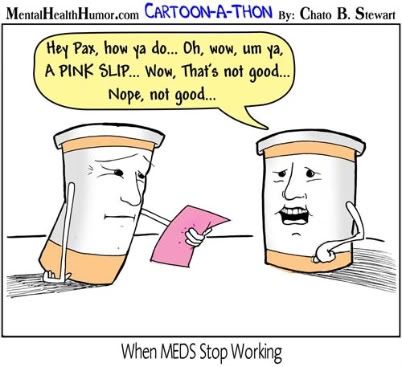
One of the things I like about Mr. Stewart and his humor is his ability to point out the humorous side of what it is like to live with a mental illness. For me, it takes some of the seriousness out of the situation and allows me to see some of what I have encountered in a less discouraging light. I have posted two of his cartoon creations. I encourage you to visit his site and see his other work.


Mental Health Humor
Permission to use by Chato B. Stewart


Mental Health Humor
Permission to use by Chato B. Stewart

The Impact Of Physical Illness On Mental Health – Mental Health Awareness

I believe that my physical illnesses contributed to the poor state of mind I had, as well as developing Clinical Depression, and an Anxiety Disorder. I went from being a relatively healthy person to someone who physically feels rotten much of the time. Also, several of the medications I am on to treat the diabetes and the asthma have been shown to directly affect your brain and lead to depression, especially, if you are already prone to depression or anxiety.  My counselor calls it co-morbidity.

I believe I have a better attitude and outlook about my physical illnesses. When I was in the hospital for my asthma in February,  I was not down in the dumps like I would have been before. Being there on my fortieth birthday did not bother me. I even kept blogging while I was there. I would have the nebulizer in my mouth, for a breathing treatment, and I would be blogging away at the same time. I also think my depression medications help counter how my other medications might affect my brain chemistry.

The Impact of Physical Illness on Mental Health


There is one particular aspect of  mental health that is still not widely discussed.  It is the impact that physical illness has on a person’s mental health.  Mental health workers easily recognize this fact, everyday they see patients with a multitude of physical and mental issues.  Unfortunately, few outside the mental health field see the correlation.

One way to put it in perspective is to think about how you feel when you have a cold.  Obviously, you have a stuffy nose, runny eyes, a fever, and you just feel physically awful.  How about the mental aspect of it?  Many people get cranky, and a bit irritable.   Very often it goes deeper than that.  Many people feel “blue” or “down in the dumps” when they have a cold.  I know I get really whiny when I have a cold.  The good thing is we know that a cold is not going to last very long, most of the time, and soon we will be back to feeling like ourselves.

Now think about this, what if the cold turned into a long term illness?  How do you think that would affect your mental health?  Most people, no matter how mild or serious the illness is, experience a wide range of emotions.  Emotions like anger, sadness, and worry.  We feel like we have no control and that our bodies have let us down.  We feel lonely, and even though there probably have been millions of other people with the same illness, we feel as if no one really understands what we are going through.

From a mental health perspective, when it comes to a chronic or long-term illness, anxiety and depression are the biggest concerns.  Many times these mental health issues  are  over-looked and left untreated.  Which can be very dangerous from both a mental health perspective, it can lead to suicide, and from a physical health perspective, it can delay healing.

Doctors are becoming more aware of how physical illnesses can affect mental health and attempt to be on the look out for the signs and symptoms of anxiety and depression.  However, their best source of information about how you are doing mentally, is from you.  Your doctor will not be aware that you are having any mental health issues if you are not open and honest with them about what is going on in your life and how you are feeling.

Why are depression and anxiety more likely to happen when you have a physical illness?

  • People become depressed and anxious when they are stressed for any reason.  Being ill is stressful.
  • Some drug treatments, such as steroids, affect the way the brain works and can directly cause anxiety and depression.
  • Some physical illness, such as an under-active thyroid, affect the way the brain works and can directly cause anxiety and depression.

You are more likely to experience severe anxiety and depression when you are physically ill if:

  • You have been anxious or depressed before.
  • You do not have family or friends you can talk to about your illness.
  • You are female (women report more anxiety and depression than men).
  • You have other problems or stresses going on in your life at the same time.
  • You are in a lot of pain.
  • Your illness is life threatening.
  • Your illness has left you incapable of taking care of yourself.

Clinical Depression – Mental Health Awareness

I was diagnosed last year with Clinical Depression. My diagnosis came after several years of suffering, and a suicide attempt. When I compare how I feel now to how I felt this time last year, I am amazed at the difference. Even my soul feels refreshed.

I will always have Clinical Depression, however, my goal is to never allow myself to get that sick with it again. Everyday, I look for any signs that my medications might not be working. I have family members whose job is to watch and see if I exhibit any signs of a set back. I have plans in place in case my medications ever stop working, and I need some extra help for a time. I believe all of these are productive steps in my plan to stay as healthy as I can.

Clinical Depression


Depression affects more people than any other mental illness, more than about 19 million Americans each year.

Clinical Depression is more than just being down in the dumps, or feeling blue.  It is a real illness, and it can be treated.  Unfortunately, most people who have depression do not seek help.

Many people are intimidated by the stigma that surrounds depression or other mental health issues, and as a result do not want to let anyone know they need help.  Others believe depression is just a normal part of  life’s ups and downs, and do not realize that it is a real illness, causing them to delay seeking help, or to never seek it at all.   It is important for people to know that depression is a real illness, and there are many effective treatments for it.

Some signs of depression are:


  • A persistent feeling of sadness, anxiety, or an empty feeling
  • Difficulty falling asleep, staying asleep, or sleeping too much
  • Reduced appetite and weight loss or increased appetite and weight gain
  • Loss of interest and pleasure in once enjoyable activities
  • Restlessness, or irritability
  • Difficulty in concentrating, difficulty in remembering things, or difficulty making decisions
  • Fatigue or loss of energy
  • Feeling guilty, hopeless or worthless
  • Thoughts of suicide or death

If you have been experiencing five or more of these symptoms for two weeks or longer, there is a possibility that you may have depression.  Seek professional help immediately.

If you are a family member is in crisis right now call 1-800-273-TALK or dial 911

Thursday Thirteen – Myths

My Thursday Thirteen for this week is Thirteen Myths about Mental Illness

1. Myth-Psychiatric disorders are not true medical illnesses like heart disease and diabetes. People who have a mental illness are just “crazy.”

Fact-Brain disorders, like heart disease and diabetes, are legitimate medical illnesses. Research shows there are genetic and biological causes for psychiatric disorders, and they can be treated effectively.

2. Myth- People with a severe mental illness, such as schizophrenia, are usually dangerous and violent.

Fact-Statistics show that the incidence of violence in people who have a brain disorder is not much higher than it is in the general population. Those suffering from a psychosis such as schizophrenia are more often frightened, confused and despairing than violent.

3. Myth-Mental illness is the result of bad parenting.

Fact – Most experts agree that a genetic susceptibility, combined with other risk factors, leads to a psychiatric disorder. In other words, mental illnesses have a physical cause.

4. Myth- Depression results from a personality weakness or character flaw, and people who are depressed could just snap out of it if they tried hard enough.

Fact-Depression has nothing to do with being lazy or weak. It results from changes in brain chemistry or brain function, and medication and/or psychotherapy often help people to recover.

5. Myth-Schizophrenia means split personality, and there is no way to control it.

Fact- Schizophrenia is often confused with multiple personality disorder. Actually, schizophrenia is a brain disorder that robs people of their ability to think clearly and logically. The estimated 2.5 million Americans with schizophrenia have symptoms ranging from social withdrawal to hallucinations and delusions. Medication has helped many of these individuals to lead fulfilling, productive lives.

6. Myth-Depression is a normal part of the aging process.

Fact- It is not normal for older adults to be depressed. Signs of depression in older people include a loss of interest in activities, sleep disturbances and lethargy. Depression in the elderly is often undiagnosed, and it is important for seniors and their family members to recognize the problem and seek professional help.

7. Myth-Depression and other illnesses, such as anxiety disorders, do not affect children or adolescents. Any problems they have are just a part of growing up.

Fact- Children and adolescents can develop severe mental illnesses. In the United States, one in ten children and adolescents has a mental disorder severe enough to cause impairment. However, only about 20 percent of these children receive needed treatment. Left untreated, these problems can get worse. Anyone talking about suicide should be taken very seriously.

8. Myth – If you have a mental illness, you can will it away. Being treated for a psychiatric disorder means an individual has in some way “failed” or is weak.

Fact- A serious mental illness cannot be willed away. Ignoring the problem does not make it go away, either. It takes courage to seek professional help.

9. Myth-Electroconvulsive therapy (ECT), formerly known as “shock treatment,” is painful and barbaric.

Fact- ECT has given a new lease on life to many people who suffer from severe and debilitating depression. It is used when other treatments such as psychotherapy or medication fail or cannot be used. Patients who receive ECT are asleep and under anesthesia, so they do not feel anything.

10. Myth-Most people with mental illness live on the streets or are in mental hospitals.

Fact-Over two-thirds of Americans who have a mental illness live in the community and lead productive lives. Most people who need hospitalization are only there for brief periods to get treatment and are then able to return home, just like people hospitalized for other conditions. Some people with mental illness do become homeless and could benefit from treatment and services.

11. Myth – I can’t do anything for a person with mental illness.

Fact-You can do a lot, starting with how you act and speak. You can create an environment that builds on people’s strengths and promotes understanding. For example:

Don’t label people with words like “crazy,” “wacko,” or “loony” or define them by their diagnosis. Instead of saying someone is “a schizophrenic,” say he or she “has schizophrenia.”

Don’t say “a schizophrenic person,” say “a person with schizophrenia.”

Learn the facts about mental health and share them with others, especially if you hear something that isn’t true.

Treat people with mental illnesses with respect and dignity, just as you would anybody else.

Respect the rights of people with mental illnesses and don’t discriminate against them when it comes to housing, employment, or education.

Like other people with disabilities, people with mental health problems are protected under federal and state laws

12. Myth-Mental illness is a single, rare disorder.

Fact-Mental illness is not a single disease but a broad classification for many disorders. Anxiety, depression, schizophrenia, personality disorders, eating disorders and organic brain disorders can cause misery, tears and missed opportunities.

13. Myth- If you think someone has a mental illness, you should wait to do something until she asks you for help.

Fact-Addressing the problem as soon as you notice symptoms usually results in earlier treatment and a better outcome. If you notice a friend is behaving differently than usual, you should encourage her to seek help and discuss her problems.Reassure your friend that you’re available for support. If she refuses to seek help, make an appointment with a professional to discuss the situation and the available options.

I Am A Failure

There is no doubt in my mind, I am a failure. It would take more fingers and toes than I have to count how many times I have failed. I have failed so many times, that I cannot even remember all of my failures. Some of my failures have been huge, and embarrassing, others have been rather small and I was the only one aware of the failure. Sometimes it has felt as if I have failed more than the average person has.

I have spent a lot of time and energy over the years recounting my failures. I spent so much time recounting my failures that telling myself what a failure I was became a part of my negative internal dialogue. Many times I would relive the failures all over again. I would feel the same feelings of embarrassment, disappointment, anger, and etc., that I had felt when I had the original failure. Then I would start kicking myself for being so stupid and for being such a failure.

My biggest failure was when I gave up. Just literally gave up on everything, including life. So I tried to commit suicide. I had given up, what was the point of being here anymore?

A few weeks ago my counselor pointed something out to me. She brought to my attention that even though I have failed many times, even to the point of attempting to commit suicide, I have also picked myself up and dusted myself off each and every time. Sometimes it was easy to pick myself up, and other times it took more time and energy, but I have always picked myself up at some point. One example she used was with regards to my depression and how once the medications started working I threw myself into learning how to manage it.

Even after the counselor pointed out the positive things about my failures, I still had a real problem with seeing failure as a positive thing. The main reason is that failing hurts. Then I read a blog post titled Secret Tips To Overcome Your Fear Of Failure written by Aaron Wong, that helped me see failure in a different perspective.

In this post Mr. Wong states

“Changing the way we view failure from a bad thing into an opportunity, is like making lemonade out of lemons in life.”

I realized I had some choices. I could choose to continue to see my failures as bad, or I could choose to embrace my failures. I could continue to beat myself up about my failures or celebrate the successes that came out of those failures. The choice seems obvious to me. It is time for me to use my positive thinking techniques on my failures.

When I took the time to look at my failures from a more positive perspective, I realized that each and every time I failed I learned something about myself. As the counselor pointed out, at some point I would attempt whatever it was again, but in a different way, sometimes it would work, other times I would still fail. The point is, I would would keep trying until I succeeded or exhausted all possibilities and found a different way to accomplish my goal.

Having a lot of failures is not a bad thing. Failures indicate a measure of courage, because you are willing to take some risk to accomplish your goals. Failures can really be viewed as victories, if you are willing to pick yourself up and keep trying.

We are all failures — at least, all the best of us are. ~ Sir James M. Barrie

Now the word failure has a different meaning for me. To me failure means victory. I am going to proudly wear the failure label with a grin on my face.

Say What You Mean…

There have been many times over the last few years when I would share with someone what I needed or wanted, only to find that it was as if they never even heard me.  I never could understand what it was about me that seemed to make it so difficult for people to hear and fulfill my wants.

Somewhere along the way in my therapy, I realized why people did not hear what I was saying.  I was not really saying what it was that I wanted and needed.  I would beat around the bush, alluding to what it was that I wanted, but never actually saying it.  I learned that if I want to be heard,  I need to say what I mean and mean what I say.

“Then you should say what you mean,’ the March Hare went on. `I do,’ Alice hastily replied; `at least – at least I mean what I say – that’s the same thing, you know. “~ Lewis Carroll

Every time I did not say what I meant, and mean what I said, I diminished my own self worth, and my power.  I  also ended up feeling frustrated, disappointed, and ignored.  I felt as if I had no voice.   Those feelings contributed to the extreme unhappiness I always seemed to have.

There are several reasons why I chose to not say what I meant.  In the past, it was an act of self preservation.  I have had relationships with people and family where expressing what I really thought could have led to a great deal of unpleasantness.  I would use hinting around about the subject I wanted to discuss as a way to gauge what the other person’s reaction might be.  Later on in life I became the ultimate people pleaser, and did not see myself as valuable as everyone else.  By never being direct about what I wanted, I could make sure everyone else’s wants and needs were taken care of.

Once I saw myself as valuable and decided to live a truthful life, a life where I was being the real me,  I began to start saying what I meant.  I was surprised at the results.  Most of the people in my life where very happy that I was telling them what I needed and wanted.  It allowed them to know what I was thinking, and gave them an opportunity to do things for me.  It made them feel as if they were a part of my life.

The more I said what I meant and meant what I said, the more confidence and feelings of self worth I gained.  Which led to me being more and more direct.  I no longer felt ignored and frustrated.  I became a happier person.  Since I was no longer worrying about whether people got what I was alluding to, I also became less anxious.

Say what you mean and mean what you say is something I attempt to live up to every day.  It is not always easy, old habits can be difficult to overcome.   However, as each day goes by and I have more and more opportunities to practice being direct, the easier it has become.  My belief,  is that one day, I will be able to say what I mean and mean what I say without even having to give it any thought.

Do you always say what you mean?  If not,  why?

If you do not always say what you mean, how does that make you feel?

If you are someone who does say what you mean, have you always done so?

What made you start saying what you mean and meaning what you say?

I am looking forward to everyone’s answers.