The Stigma Of Suicide – Mental Health Awareness

Society has preconceived ideas about people with a mental health issue. Not only does this stigma cloud how people view the actions of someone with a mental illness, it also determines how a “normal” person believes someone with a mental illness should look. So when I attempted suicide last year, it took  many people by surprise. They had this idea that I was “too smart to ever do anything so stupid”, and I did not fit into their idea of what a person with a mental illness should look like.

Many people think that if  someone attempts suicide they are weak or have some sort of character flaw.  Some have religious  beliefs that say suicide is an unforgivable sin.  In the face of such negativity, is it any wonder that many people with suicidal thoughts will not reach out for help?

People who are suicidal are not weak nor do they have a character flaw.  They are individuals with very real illnesses who need understanding, respect, and care, not judgments and misunderstanding.

The Stigma Of Suicide


The stigma associated with mental illness prevents many people who are at risk of suicide from seeking help for treatable problems.  The stigma of suicide itself may also reduce the number of people who reach out for help, and adds to emotional burdens.    Family members of suicide attempters often hide the behavior from friends and relatives, since they may believe that it reflects badly on their own relationship with the suicide attempter or that suicidal behavior itself is shameful or sinful. Persons who attempt suicide may have many of these same feelings. Those who have survived the suicide of a loved one suffer not only the grief of loss, but the pain of isolation from a community that may be perplexed and uninformed about suicide and its risk factors.

Historically, the stigma associated with mental illness, has contributed to inadequate funding available for mental health services and suicide prevention programs.  It also contributes to insurance companies not providing enough health care coverage for mental health services.

Until the stigma is reduced, treatable mental health problems, including those with a strong relation to suicide, will continue to go untreated and crisis treatment services will also be limited.  This means, the number of people at risk for suicide will remain much higher than it should be.

If you or a loved one is in imminent danger of committing suicide call 911 immediately.

National Suicide Hotlines, USA

Unites States of America

1-800-SUICIDE–1-800-784-2433                           1-800-273-TALK–1-800-273-8255

1-800-799-4TTY–1-800-799-4889  (Deaf Hotline)

In The Company Of Greatness – Mental Health Awareness Month

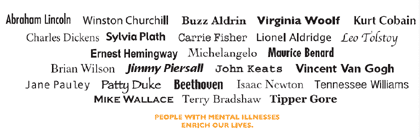
Struggling with a mental illness can make life seem bleak.  It can be inspirational to learn that many of the world’s most famous people have had or currently have a mental illness.  This includes writers, entertainers, artists and political leaders.

  • Isaac Newton – He was the most famous mathematician of the 17th Century, and was responsible for many scientific discoveries we take for granted today. Such as the “corrected” Gregorian calendar date. Newton’s greatest mathematical discovery was the gravitational relationship between the earth and the moon, and of centrifugal force. Newton was well educated, had access to the best knowledge of his day, and was wealthy in later life. In 1705 Newton was the first Scientist to be  knighted by Queen Anne for his great scientific contributions. He suffered from several “nervous breakdowns” in his life and was known for great fits of rage towards anyone who disagreed with him. Some have have said that he had Bipolar Disorder, which was unknown at the time.
  • Linda Hamilton – Best known for her role in “Terminator”, Linda Hamilton  was diagnosed with bipolar late in life, and refers as the years from ages 20 to 40 as “her lost years”. Her rages and mood swings destroyed her marriages and, despite her considerable professional success, she describes her life before treatment as “bleak”.Linda Hamilton’s Interview with Larry King
  • Joe Nash– As a Nobel Prize Winner in mathematics, he has faced a lifelong battle with schizophrenia. He was known as the “Phantom of Fine Hall” at Princeton where his reclusive, ghost like figure could be seen roaming around, leaving messages of his mathematical genus on the boards of empty classrooms. His struggle was well documented in the book “A Beautiful Mind,” by Sylvia Nasar which was later made into a movie by the same name.
  • Ashley Judd – She once spent 47 days in a treatment facility for depression and other emotional problems.  She says
  • “It’s so simple really: I was unhappy and now I’m happy,” she says. “Now, even when I’m having a rough day, it’s better than my best day before treatment.”

  • Brooke Shields – She was diagnosed with Postpartum Depression.  She first had difficulty bonding with her baby and later thought of hurting it and even killing herself. She was able to gain a significant improvement in her mood through medication and the help of a skilled nurse-helper who recognized her problem and encouraged her to get help.

Next week I will highlight more famous people who live or lived with a mental illness.

Parents With Mental Illness – Mental Health Awareness

There is a stigma attached to parents who have a mental illness. This stigma is more severe than for any other chronic illness, like diabetes, heart disease, and cancer. Many people believe that all parents with a mental illness are incapable of being a good parent.  They assume that the children of these parents will be emotionally scarred, abused and neglected.  This is simply not true. Most parents with a mental illness, that is being properly managed,  are no different than parents without a mental illness.

With the wide variety of mental illnesses and symptoms, there will be some parents that find it difficult to be a “good parent”.  However, studies have shown there is an equal percentage of parents without a mental illness that have difficulty with parenting.

Several mental illnesses, depression for example, commonly manifest during a person’s prime parenting years (ages 30 to 44).  This can make us question our own parenting abilities and cause us to worry about whether we are a fit parent or not.  Especially, if we have limited knowledge on what living with a mental illness is like and we have our own mistaken beliefs about the mentally ill.

As parents with a disease, the best thing we can do is get help.  Proper treatment will help us get our symptoms under control, so we can be the best parent we can be.  It will show our children that there is no shame in seeking help for our mental illness.

Here are a few tips to encourage us as we learn to manage our disease and parent at the same time.

  • Recognize the illness and get treatment
  • Recognize that it is possible to have a mental illness and be a “good parent” at the same time.
  • Recognize that staying with your treatment plan is the best way to get better.

Research has shown that “breaking the silence” and discussing a parent’s mental illness, in an age appropriate manner, can help strengthen the family unit and its individual members.  This approach has been found to be helpful in keeping the children resilient and also channeling the worry and self doubt of the parent into more positive outlets.  Like strengthening the parent-child relationship.

Some tips for a parent with a mental illness are:

  • Pay attention to your parenting and make sure your illness does not disrupt your children’s lives.
  • Make sure that your children continue to go to school.
  • Encourage your children’s participation in outside activities (sports, church, and etc.).
  • Encourage their relationships with peers and important adults in their lives (grandparents, uncles, aunts)
  • Make sure your children understand that it is not their fault that their parent is ill and that they are receiving treatment to get better.
  • Be prepared to talk more than once.  It takes families and children time to understand what is going on.  They also may need to be reassured several times that you are getting help and are working hard to get better.

The Benefits Of Having A Mental Illness – Mental Health Awareness

One of the things I had to learn in an effort to manage my Clinical Depression, was to look for the positive in everything. This was so stinking hard in the beginning. It was so outside of my nature that I have had to practice long and hard to see that life does not have to be as serious as I always thought it had to be. With that attitude in mind, I thought I would list thirteen benefits of having a mental illness. If you think of something you would like to see added to the list, put it in the comment section and I will add it.

  1. My life goes according to my schedule most of the time. One of the things that used to stress me out so much was always having to be someplace on time.  Whether it was picking up kids, or getting the grocery shopping done at a decent time, or going on outings, it would all stress me out.  Now that I cannot drive very much because of how sleepy my depression medications make me, someone else is responsible for keeping the schedule  Also because of the sleepiness, I now have a really good reason for why I do not do mornings, and why I need at least one nap a day.
  2. I am much more thankful than I used to be. I have had to learn to rely on other people.  I have had to learn how to say “I need help with something.”  That has made me appreciate the people in my life much more than I used to.
  3. I have a voice! In the past I rarely said what I meant, and meant what I said.  I was always watching what I said, out of fear of angering someone, or offending someone, or even making my needs known above someone else’s.  Now that I have a voice, I say what I mean and I mean what I say.  I am direct and honest with people, and I make my needs known.  I offer my opinions and thoughts.  I still try to not offend people, but I do speak my mind.  It is very liberating to just talk and express myself without the constant worry about who might take what I said the wrong way.
  4. I have made personal connections. When Clinical Depression began to rule my life, I lost my friends.  Most of it was due to my behavior.  I was not a very nice person before my recovery process began.  Since I have been doing better and have been putting myself out into the internet world, I have met so many wonderful people.  They know that I have a mental illness and they do not care about that diagnosis one bit.  Those friendships mean a great deal to me.
  5. No. I remember when my daughter was little and she did not want to listen to the word no.  I had a little song I that I would sing, I believe Lunette the Clown from The Big Comfy Couch was the inspiration behind it.  The words were simple and the tune could be anything you wanted.  It went something like this.  “No means no, means no, means no, means no….”  In the past saying the word no was something I struggled with.  Often that meant I would take on more than I could handle, get over-whelmed and stressed out, and then everything would fall apart.  Now when I find that I am struggling with sticking to my no, I start singing my No song and let people know that I cannot take on anymore than I already have on my plate because I have a mental illness and if I were to get overwhelmed I would very likely have a melt down.
  6. The Mail. I know this is going to sound totally insane, but I used to obsess about the mail.  I was convinced that if anyone other than me checked the mail, then there would be something disastrous in the mailbox.  Once I realized that the mail was a huge source of my anxiety, I chose to no longer get the mail from the mailbox.  Not only do I not have the stress of the mail anymore, but my husband is now in charge of the bills.  Being too anxious to check the mail got rid of two sources of stress at the same time.
  7. I have learned to laugh. I used to be so serious all the time.  Not anymore.  I have learned that laughter feels good.  I laugh at myself, I laugh with others, I laugh when I am all by myself.  I laughed when I re-read what I wrote about my mail box anxiety.
  8. My life is simple. I keep things in my life simple now.  No long exaggerated lists of things to do, clothes to wear, or suppers to cook.  Keeping things simple, frees up my time to do other things.
  9. I take risks. I will take chances now that I never would have before.  I always liked everything very predictable. Nothing could spin me out of control faster than things not going according to my plan.  Having a mental illness has taught me that nothing can really be planned.  Once I start planning, then I start worrying, then I become obsessed with worrying and then….you get the picture.  Now, for the most part, my life does not go according to a plan.   I am stepping out my comfort zone and trying new things, like writing.
  10. I have a better perspective. I have learned to not sweat the little stuff.   Because of my depression, I cannot get bogged down by the little things.  It would be too easy for it to trigger a depressed episode.
  11. I am a better person than I used to be. I had my own very negative ideas about what people with mental illnesses were like.  Now I am one of those people and I have come to realize that people with mental illnesses are not anything like I thought they were.
  12. Helping Others. Being willing to talk about my illness helps others.  It lets them know they are not alone with their thoughts and feelings and there are things that can be done to feel better.
  13. I take better care of myself. I value my life and health much more than I used to.  I spend the time and energy necessary to monitor my other illnesses and do the things I am supposed to in order to manage them.

Mental Health Bloggerss – Mental Health Awareness

I originally started blogging as a way for me to do deal with my own out of control emotions. As I have grown, changed and become less depressed, I have kept blogging as a way to make people aware of what it is like to live with Clinical Depression, and an Anxiety Disorder, and how Diabetes and Asthma can affect Mental Health.

As I have traveled around the internet, seeing other blogs, I realized that there are many people who blog for the same reasons I do. To put their own Mental Health story out there, with the hope that it can benefit someone.

For today’s Mental Health Awareness post I wanted to take the time to list five of the ones I have found. Each one tackles Mental Health from a different perspective, and some have a different mental illness than I have. Next week I will list five more.

BPD in OKC This is one of the first bloggers I began following. This part of how she describes her blog and why she blogs:

    “My life feels like I am stuck riding on a rollercoaster in the middle of a hurricane. I have ups and downs, and I have left a path of destruction in my wake. My sanity dangles on a tiny fragile string, and through this blog I am giving the world a look into my broken mind and my unstable life.”

Our Journey Through Life I love this blog! The author tells her story from the perspective of what it is like living with a spouse who has Bi-Polar Disorder. Although, I do not have a Bi-Polar Disorder diagnosis, her site has been very educational for me. It has given me insight into how my own diagnosis affects my family.

Chato B. Stewart, Mental Health Humor
This site is probably one of the best I have found. Mr. Stewart approaches the issue of Mental Health from the humorous side. His tongue and cheek humor, exhibited through his cartoons, and caricatures, is a great reminder that even though we have a serious diagnosis, we do not always have to be so serious.

The Bi-Polar Spouse This is a new site to me, but I like what I have seen so far. This is a very detailed site about what it is like living with a spouse who has Bi-Polar Disorder, and tips and strategies to help maintain a healthy relationship with them.

Up and Down Time
Another site that is new to me, but one I like. It has great information and high lights in it. It is the blog for the Colorado Chapter for Depression and Bipolar Support Alliance (DBSA)

Stigma and Mental Illness – Mental Health Awareness

I knew I was experiencing depression. I knew I needed help. I knew I was in serious trouble. However, in spite of knowing those things, I chose not to ask anyone for help. I was too embarrassed, and ashamed.  I thought people would see me as a weak person, and not want to have anything to do with me.  Even when I woke up in the hospital after my suicide attempt, my biggest concern was not that I was alive, or how close to death I had come, it was embarrassment at the fact that people would now know my secret.

Stigma and Mental Illness

Society feels uncomfortable about mental illness.  It is not seen like other illnesses such as heart disease, and diabetes.  Because of  inaccurate information and misunderstanding, people have been led to believe that people with a mental illness are weak, or dangerous.

Due to stigma, the typical reaction someone with a mental illness encounters is fear and rejection.  As a result, many people with this disease lose self-esteem and have difficulty making friends.  The stigma attached to mental illness is so much a part of our thinking that people who suspect they are mentally ill, will not seek help out of fear of what others will think.

Here are some common myths that may be used to justify negative feelings about people with a mental illness.

  • Myth: Mental illness is fairly rare and does not affect average people.
  • Fact: Mental illness is quite common.  According to the American Psychiatric Association, one in five Americans suffer from a mental disorder in any given year.  Mental illness can strike people of any age, race, religion, or income status.
  • Myth: People with mental illnesses are dangerous.
  • Fact: This powerful myth has been fed by the media. In fact, the vast majority of people with mental illnesses are not dangerous. They are much more likely to be the victims of violence and crime than the perpetrators.
  • Myth: Mental illness is more like a weakness than a real illness.
  • Fact: Mental illnesses are as real as other diseases like diabetes or cancer. Some mental illnesses are inherited, just as some physical illnesses are. They are not the result of a weak will or a character flaw.
  • Myth: People with mental illnesses can never be normal.
  • Fact: Science has made great strides in the treatment of mental illness in recent decades. With proper treatment, many people with mental illnesses live normal, productive lives.

There are things we can do to reduce the stigma and make things easier for the millions of people who live with a mental illness.

1. Educate yourself about mental illness. Having the facts can help you challenge the misinformation that leads to stigma.

2. Be aware of words. Don’t reduce people to a diagnosis. Instead of “a schizophrenic,” say “a person with schizophrenia.” Correct people who use hurtful language to describe people with mental illness, such as “psycho” or “crazy.”

I have a confession…I often refer to myself as “crazy” and that “I have the papers to prove it”.  I never realized that this might be adding to the stigma that already exists, my only thought was that it made my daughter laugh.

3. Challenge media stereotypes. Write letters to any newspapers, TV or radio stations that promote negative portrayals of people with mental illness.

This advice is great for someone who has reached a point in their recovery process where they feel they are equipped and capable of doing this.  However, at this time, the most I can do to change media stereotypes is to talk about it on my blog.  That is a comfortable place for me to tackle difficult issues.

4. Support those with mental health issues. Treat them with respect. Help them find jobs or housing. Encourage them to get or stick with treatment.

Encouraging people is something I can do.  When I go to my counseling appointments now, I make  a point of speaking with other patients in the waiting area.  Many times I make a point of speaking to someone that I would not have spoken to in the past.

5. Share your story. If you or someone in your family has had a mental illness, speak up about it. Your example could help someone else.

I have been sharing my story for months on my blog.  It is easy to do there because I can hide behind a computer screen.  I am slowly becoming more comfortable sharing my story in person, attaching a face to the story.  I can see that it does make a difference.

Steps to Cope with Stigma

There are some things we can do to cope with the stigma that surrounds people with a mental illness.

  • Get treatment. Do not let the fear of being “labeled” prevent you from seeking diagnosis and treatment.  Diagnosis and treatment can relieve a great deal of stress and tension by identifying what is wrong in concrete terms, and reducing symptoms that interfere with work and your personal life.
  • Do not let stigma create self-doubt and shame. One of the best ways to minimize the stigma about mental illness is to come to terms with your illness.  Feeling ashamed, embarrassed or humiliated because of something that is beyond your control is very destructive.
  • Seek support. Although you might not feel comfortable telling anyone anything about your condition, it is important to do so.  If you tell people you trust, you may find compassion, support and acceptance. Stigma can lead to social isolation, making it extremely important to stay in touch with family and friends who understand.
  • Don’t equate yourself with your illness. You are not your illness.  Instead of saying “I’m bipolar,” say “I have bipolar disorder.”  Do not say you “are depressed.”  Say you “have depression.”
  • Use your resources. In the United States there are federal, state, and nonprofit resources available to you.  You may have to look for them.  You can get a friend or family member to help you search out the resources you can use.

Even though I am technically disabled, I cannot get disability.  The reason is because I chose to be a stay home mother for many years,  I do not have enough job credits in the Social Security System.  However, I have found help.  I have gotten a year’s worth of free medications from the drug manufacturers, by filling out the proper paperwork and submitting it to them.  The psychiatric clinic I go to gets government funding, so at this time, based on my husband’s income I do not have to pay for my appointments.

I believe that if we all work together and do what we can, we can erase the stigma that surrounds people with mental illnesses.

Sex and Mental Health- Mental Health Awareness Month

Content Warning:  This post contains mature subject matter. This topic may not be suitable for everyone. The topic of sex is discussed. However, it is discussed in a tasteful manner.  It is your decision and sole responsibility if you choose to read past this warning.

I have to admit this is a difficult, and embarrassing topic for me to talk about.  I am just not comfortable discussing sex with anyone but my husband.  However, since I am committed to doing my part in raising awareness about mental health issues, and how to maintain good mental health, I felt that this was an important topic to discuss.

I am just like most adult women in the world, I enjoy sex and I enjoy how it makes me feel.  It makes me feel relaxed and less stressed. It also helps strengthen my relationship with my husband.

Sex and Mental Health

Sex is more than just a moment of pleasure.  Many experts agree that sex has several health benefits, including helping to maintain good mental health.

  • Sex is a great stress reliever. Studies have shown that sex can lower our blood pressure and is a big stress reducer.  Frequent (meaning once or twice a week) intercourse between partners who live together, can lower diastolic blood pressure.
  • Sex improves immunity. Good physical health, means we have a better chance at having good mental health.  Frequent  sexual intercourse can affect our physical health by improving our immune system.  It has been linked with increasing our levels of an antibody called immunoglobulin A, which can protect us from catching colds, other viruses and infections.
  • Think thin. Sex is a great way to burn calories.  It can burn between 75 to 150 per half an hour.
  • Sex improves cardiovascular health. Eating a healthy diet, maintaining good cholesterol levels and watching your sodium intake are all good for the heart, but so is sex.  It raises our heart rate and increases blood flow.  Frequent sexual intercourse can also reduce the risk of a fatal heart attack by half.
  • Sex improves intimacy. Having sex and orgasms increases the levels of a hormone called oxytocin, sometimes referred to as the “love hormone”.  It lets us feel the urge to nurture and to bond.
  • Sex reduces pain. As the levels of oxytocin increases in our bodies so does endorphins.  As the endorphins increase our pain is reduced.  A headache is no longer a valid excuse to not have sex.  It also reduces arthritis pain and PMS symptoms.
  • Sex boosts self esteem. It seems that many people have sex because it makes them feel good about themselves.  If you are in a committed and loving relationship, sex can raise your self esteem.
  • Sex helps you sleep better. Getting enough sleep does wonders in maintaining good mental health and physical health.  The hormone oxytocin that is released during orgasm also helps you sleep.

I would like to thank Dr. Joy Davidson for her advice and encouraging words about my discussing this topic.  She can be found at The Joy Spot

Pets and Mental Health – Mental Health Awareness

I love having a dog. For me, that unconditional love and acceptance I get from them is irreplaceable. Just petting Minnie’s little head, or having her curl up under the covers with me makes me feel good.  I can talk to her and she listens, at least I think she does. She seems to know when I am not feeling well, because she will curl up next to or on me and comfort me.

She keeps my mind busy and occupied because of the care she requires.  Clipping her nails, giving her baths, and throwing toys for her.  I love giving her baths.  She smells so good afterward and the way she runs around like a maniac after I finish bathing her makes me laugh.  I love what she does to get my attention.  When I have my computer in my lap and she has decided that she needs me, she will climb up in my lap and drop her toy on my keyboard.  She never gets mad at me and she is very easy to please. She is a good companion and does a lot in helping me maintain a positive attitude.

Pets and Mental Health

Pets can be good for our mental health.  A pet cannot cure depression or anxiety, nor is it a substitute for medication or talk therapy.  However, a pet can help improve mild to moderate depression in some people, as well as being helpful for people with anxiety disorders and other psychiatric disorders.

Some Benefits of Pet Ownership.

  • Pets can help ease loneliness or isolation. They accept us for who we are and do not judge us.  They also help us stay connected with other people, by providing us with a topic of conversation and by giving us something we have in common with many other people.
  • Physical contact is important to our mental health. Stroking and cuddling with a pet is therapeutic. It relieves stress and anxiety.
  • Animals improve our mood with their companionship. We are also likely to laugh and be more playful when we share our home with a pet.
  • Pet owners are more active. The exercise we get from walking, feeding, and grooming a pet keeps our minds healthy.
  • Routine is beneficial to emotional stability. Caring for a pet provides a predictable routine and a link to reality.

Some things to remember before you rush out and get a pet.

  • If you are already so depressed that you are having difficulty taking care of yourself, having a pet is going to make it worse.
  • If someone is not a “pet person” than getting one is not likely to help improve their life.

However if the conditions are right, pets can help mental health.  The benefits can come from all kinds of pets and not just from dogs and cats.  Even watching fish in an aquarium has been shown to ease muscle tension and lower pulse rates.

My Mother's Day Present – Mental Health Awareness

As a mother with Clinical Depression and an Anxiety Disorder, I have not always been the parent I should have been. I spent three years in bed, barely able to function, while my daughter had to take care of herself. I traumatized her by attempting to commit suicide and having to be hospitalized. I hurt her when I told her I did not want her around me. By the time I started my recovery process, she was a sad, angry young lady, who no longer trusted me.

Last November my daughter wrote me a letter. In it she expressed how she felt about me, my depression, and how it affected her. With her permission, I wrote a post about her letter. Here is some of her letter and parts of that post:

“I miss the mom I used to have. I miss the mom who would do anything and everything. I miss the mom who would spend time with me. I miss the mom that I could talk to. I miss my fun and loving mom.”

Sadness, hurt, abandonment, tears, and pain are some of the words I think of every time I read that. I feel so sorry for the child who is expressing those feelings. I feel such utter sadness because the child who wrote those words is my daughter.

“I feel like you have pushed me away. I feel like you don’t really mean I Love You.”

I just want to cry when I see those words. I cannot blame her for thinking that though. In my checked out, depressed state I did push people away, including her and my husband. The thought processes going on in my head at the time rationalized me pushing them away. I told myself that by pushing them away, I was getting them used to taking care of themselves. Which meant when I decided the time was right for me to end my life, it would make it easier for me to go through with it.

Since receiving that letter from her, I have worked so hard on our relationship, and I can say that we have made huge progress. She feels comfortable with me and trusts me again. We talk to each other much more than we ever have and we have grown very close. I enjoy my time with her.

Friday afternoon, she came to me and said she could not wait any longer. She gave me two pieces of paper and said “Happy Mother’s Day”. On one piece of paper was a beautiful picture she had drawn. On the other was a letter she had written me. Not only is that letter proof of how much our relationship has changed, it also is the most wonderful gift I have ever been given. With my daughter’s permission I am going to post what she wrote to me.

Mom,
First off, I would like to say Happy Mother’s Day and I hope you like or love the picture, even though it sucks.  You’re the greatest mommy in the world  =) and I think if you were to ask  Minnie, she would bark in agreement.  So I just want to say you are the greatest every day, every month, every year, every hour, that includes the hours that you sleep and snore like a mad woman. =)  So Happy Mother’s Day and I love you a lot…I should be writing letters every day instead of on a day picked out for all moms.

This letter sounds so much more positive than the last one she gave me. In it I can see and feel how much happier she is. Working on our relationship was one of the hardest things I have had to do in my recovery process, but I am so happy that both of us were willing to do what needed to be done. I am looking forward to a lifetime of enjoying her company and loving her.

Saturday Silliness – Mental Health Humor


THE 12 WARNING SIGNS OF GOOD HEALTH*

(If several or more appear, you may rarely need to visit a doctor.)

1. Regular flare-ups of a supportive network of friends and family.
2. Chronic positive expectations.
3. Repeated episodes of gratitude and generosity.
4. Increased appetite for physical activity.
5. Marked tendency to identify and express feelings.
6. Compulsion to contribute to society.
7. Lingering sensitivity to the feelings of others.
8. Habitual behavior related to seeking new challenges.
9. Craving for peak experiences.
10. Tendency to adapt to changing conditions.
11. Feelings of spiritual involvement.
12. Persistent sense of humor.

Mental Hospital Interview

Dr. Leroy, the head psychiatrist at the local mental hospital, is examining patients to see if they’re cured and ready to re-enter society.

“So, Mr. Clark,” the doctor says to one of his patients, “I see by your chart that you’ve been recommended for dismissal. Do you have any idea what you might do once you’re released?”

The patient thinks for a moment, then replies, “Well, I went to school for mechanical engineering. That’s still a good field, good money there. But on the other hand, I thought I might write a book about my experience here in the hospital, what it’s like to be a patient here. People might be interested in reading a book like that. In addition, I thought I might go back to college and study art history, which I’ve grown interested in lately.”

Dr. Leroy nods and says, “Yes, those all sound like intriguing possibilities.”

The patient replies, “And the best part is, in my spare time, I can go on being a teapot.”