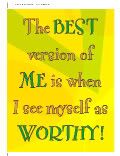
I See Myself As Worthy

Every one of us is born with an intrinsic value. We all possess the potential to make the world a better place, to bring joy and happiness to others. We have the potential to live fulfilling lives. However, for many of us something happens, and we have no feelings of self-worth. We believe that we do not deserve happiness, success, respect, to take care of ourselves and etc.

The reality is, we never actually lose our value. Never. We just believe we have. Sometimes it is because we have childhood trauma, or have been horribly picked on by childhood peers. Even experiences we have had with other people as adults could have helped us develop feelings of no self-worth. Often when we feel that we have no self-worth we hide ourselves away, feeling empty and alone, in other words we are experiencing depression.

For many years, in fact for probably most of my life, I felt that I had no value, no self-worth. I was a very unhappy and sad person. It has taken a year of therapy for me to see my value. I have wondered why I, and women like me, would choose to live in such a state of unhappiness. I do believe it is a choice.  I have come up with a couple of reasons why I think we choose to live that way.

As crazy as it might sound, I think believing that you have no self-worth is a safe option. Since we see no value in ourselves we already know that other people will see no value in us. Which means we are better prepared for rejection than most people would be. So when rejection comes along, like it always does, our internal dialogue tells us that it won’t ruin our lives, we already knew it would happen, because we have no value.

Having no self-worth is also an easy option. If we have no value, then there is no need for us to do well or even try and succeed at anything. People will leave us alone if we act like our opinions and thoughts have no value. If we believe and say that we have no talents, or that we are useless then people will expect less of us.

Fortunately since possessing a feeling of self-worth is a choice, there are things we can do to regain our sense of value. What we have to do may seem difficult at first, but in my opinion it seems that way because it is something we are not used to doing.

I really believe making a real and accurate assessment of our strengths, and talents is very important. I was fortunate that I had my counselor to point out strengths that I was not even aware of. If you feel you need to, get someone you can trust to help you list your strengths and talents. Also, take the time to list the good things you do. Use what you have written down as a jumping off point in believing you have self-worth.

Commit to yourself that you are going to work on building your self-esteem and believing you have value. Look for the positive in every situation, even the ones that at first glance seem bad. My goal is always to try and find three positive things in every situation. Smile! Even if you do not feel like smiling, smile. Take the time to share kind thoughts and caring emotions. Be curious, optimistic, and courageous. Work hard and take the time to have fun. Reduce the time you spend feeling sorry for yourself.

Finally, you know yourself better than anyone, be your own judge. Or if you do not feel comfortable being your own judge, find someone you trust to help you. I use my counselor that way. Sometimes I have a difficult time with identifying real emotions, so I will run things past her and make sure my assessment is fairly accurate and realistic. In the end, it is up to you to decide your worth and to live up to your realistic expectations.


Hiding Under Blankets

Hiding under blankets used to be my favorite pass time when I was depressed or feeling anxious. I could get my whole body under them, toes and all. Not a tiny bit of me would be exposed. The only thing bothersome about it was that since I was completely covered up, the air would get slightly stale. I had a solution for that. I would just slip my c-pap on and I could stay under the covers for hours and hours.

For the first few months that I was seeing my counselor, she was fully aware that I was still using my hiding technique as a way to cope. When she finally let me know that she thought that I could manage my depression and anxiety without hiding under blankets I was scared. I honestly did not think I had progressed enough to manage my anxiety and depression without my hiding technique. Then she just had to go and make things worse. She told me that I would have to get up in the mornings, take my shower, and get dressed so I would not be as tempted to go back to bed and hide under blankets. In my head I knew I would end up a quivering ball on the floor, crying for my blankets.

The reality of what happened was completely different. For the first few weeks, when I would feel anxious or I was having a bad mental health day, I would really , I mean really, really want to hide under blankets. I would resist the urge though. After a few weeks of resisting the call of hiding, I began to realize that hiding under blankets was not my first choice when I was experiencing anxiety or feeling extra depressed anymore. I had replaced that hiding habit with other things to do as a way to keep myself occupied until I could work through whatever it was that was causing me extra depression or anxiety.

I still get anxious and I still have depression. Those things are still there. However, I have coping skills that I did not have before. I may have lost my blankets, but I have also lost that powerless, paralyzed feeling that I used to get when the anxiety would strike. In my book that is a good trade off.

Have you ever been overwhelmed with anxiety?

If so how did/do you manage it?

If you manage your anxiety well, what tips do you have for those of us who do not?

My inspiration for writing this post came from Jodeen-Kitterman-Leck at A Road Newly Traveled

I am looking forward to your answers, Neighbors!

Do You Care?

Everyday I wake up thankful. What a wonderful feeling that is. I am thankful for many things, what I am most thankful for is the people in my life who care. Not just caring for me, but in general they care for others. They do not have to care about other people, they just do.

It is easy to see the evidence of the physical things that people do out of caring for others. What we cannot see as easily is how these acts of caring affect people spiritually. Even doing something as small as bringing someone a cup of water can affect them spiritually.

I think this quote by Mother Teresa points out how physical needs are tied to spiritual needs.

“Hungry not only for bread – but hungry for love. Naked not only for clothing – but naked for human dignity and respect. Homeless not only for want of a room of bricks – but homeless because of rejection.” ~Mother Teresa

I believe that most people feel that they do not have anything beneficial to offer another person. What they do not realize is that the simplest act of caring can bring hope to the hopeless, strength to the weary, and a feeling of joy to those who are sad. I even believe it can save someone’s life.

Do you care?

Have you ever done something for a stranger because you cared?

Have you ever wanted to perform an act of caring for someone but did not because you did not think it would make a difference?

If an opportunity presented itself for you to perform an act of caring would you do so now?

I challenge you to perform an act of caring, Neighbors.

Living A Truthful Life

Are you living a truthful life? What does living a truthful life mean anyway? To me, living a truthful life means living an authentic life. It is a life where you are honest with yourself and the others in your life. It is life that follows the old saying of “The Truth Will Set You Free”. Stacy Sheasby of Inspring Joy Today does an excellent job of explaining that old saying.

Living a truthful life is not for the faint of heart. It is difficult, painful, confusing, and joyous all at the same. It requires effort, and internal introspection. It requires a person to be accountable for their own life, without any excuses.

I am attempting to live a truthful life. It is not something I have always attempted to do. In fact the majority of my life has been spent living an untruthful life. I have spent a lot of years lying to myself, lying to others, and just flat out living a lie. The different parts of me were compartmentalized. Part of me shown to this person, another part shown to me, while still yet another part for that group over there. No one, not even me, had access to the whole of me.

In her post, Stacy Sheasby, suggests that if the truth will set us free, then if we are not living a truthful life we are living in a prison. I agree with her. It is a prison of our own making, but never-the-less it is still a prison. My prison took the form of depression, a depression that endured most of my life, becoming more and more severe as I got older. Included in my prison were the Anxiety Guards, and the Panic Attack Warden. If I ever tried to step out of my depression prison cell the Anxiety Guards and the Panic Attack Warden would set off such fears in me that I always scurried back to my “safe” cell.

After many, many years in my self made prison, I grew tired, and hopeless. I chose a way of escaping that gave me an easy way out, one where I did not have to encounter the Anxiety Guards and the Panic Attack Warden. Even that escape did not work. I found myself waking up in a hospital, tethered to a bed and still in my prison.

I was told I had no choice but to begin therapy. I did. I really did not want to, but I did. The smartest move I made in my life was promising myself and others that I would always be truthful in my therapy sessions and with my psychiatrist and actually following through with that promise. So began my journey of attempting to live a truthful life. I could only manage it during those once a week, hour long sessions, but at least it was a beginning.

As time has gone by, and I have gained confidence, began to care about myself, and learned to look at and tell the truth about myself, I have gotten more into the habit of living a truthful life. It is still not easy, I do it more out of habit than actually wanting to do it, but I am attempting, every day, to live a truthful life.

I have experienced a few rewards as a result of my attempting to live a truthful life. My relationships with my family has improved. To think, all these years they have been waiting to hear what was on my mind and for me to set boundaries with them. My depression and anxiety has lessened a great deal. The best reward has been passing the lesson of living a truthful life on to my daughter and her “getting it”.

Anna recently had a accident and broke something of hers that had significant monetary value. She made the decision to not say anything to either me or her father about it. She had decided that since it was an expensive item that we would be mad if she told us. This morning I asked her about that item because I had noticed she had not been using it. She looked like a deer caught in headlights and then she ‘fessed up about the item being broken. I was mad, but I was able to use that as an opportunity to explain to her that there is nothing wrong with being mad, it is a real emotion. It is a truthful emotion. I was also able to use this incident to talk to her about living a truthful life. An hour or so after we had this conversation, she said that she “felt better” because she was no longer worried about being “found out”. She explained the feeling by saying it “felt like an annoying bug that would not go away”.

My hope is that by teaching her to live a truthful life now, she will not find herself locked up in a prison of her own making in the future. There is nothing more beautiful then someone who can live a truthful life from a young age and never has to experience the pain from being in prison for most of their life.

I have ventured more and more outside my depression prison, walking past the Anxiety Guards and Panic Attack Warden. In some ways I am still bound by that prison, but the more attempts I make at living a truthful life, the less hold depression, anxiety and panic attacks have on me. I am looking forward to the day when that prison has absolutely no hold on me.

Are you living a truthful life? Are you living in a prison of your own making? Are you honest with yourself about yourself? Are you honest with others about your thoughts and feelings? Are you honest without excuses? example, I could be happy but…

I am looking forward to seeing how everyone answers those questions.

The Art Of Procrastination

Photobucket

I read a great blog post today, written by April Whitzman, titled Procrastinating? Click Here. She approaches the topic of  procrastination from the point of view that it is a good thing if it is done correctly. She even says that procrastination can improve the quality of our lives.

On the surface, I suppose it could be very easy to totally disagree with her views about procrastination, however,April Whitzman does an excellent and humorous job in presenting her case. She actually makes a list of things she does when she is procrastinating. Here are a few highlights from her list,

Twitter: There is nothing better than reading about pointless things that celebrities have done. If you’re really into procrastinating add me and watch me be a twit! @Alleycat17

Check Facebook for updates (Warning: This can become very addictive).

Clean. You’ll be surprised how many people sweep the floors or clean their dorm rooms to avoid doing the term paper. This is a great way to procrastinate as it’s definitely more productive and of course, there’s nothing like that great feeling of seeing that floor again

I can see value in some of the ways she procrastinates, the clean one for example. While she is avoiding tackling one icky project, she works on another that she has probably been procrastinating about doing. I think it is an amazing use of time that would otherwise be wasted.

There are things you can do while you are procrastinating that will help you relax, let go of some anxiety, and attempt to relieve some stress. If you get rid of any of those things it will instantly improve your life because it would just make you feel better.

Here are some things I do when I am procrastinating:

1. I pace the house, it gets my walking in for the day.

2. I check my twitter updates and have fun posting randomness, “The pepper jack cheese tastes good on my sandwich.” You can find me on twitter @melissamashburn

3. I hate to admit it but I play Yoville and Farmville on facebook when I am procrastinating.

4. I will do the dishes. I hate doing the dishes, the only time I truly seem to motivated to do them is when I am trying to avoid doing something else.

5. I work on my blog. Not just work on a post but I start messing around with the colors, graphics and plugins.

6. I will cook something

7.To put it delicately, I enjoy some alone time with my husband.

8. I will take a nap.

9. Play with my dog

10.  Now that I have some new relaxation techniques, I will be throwing them into my procrastination arsenal

I have to say, looking at procrastination in this way eliminates any guilt I was harboring about my own procrastination habit.   With less guilt, comes less stress, less stress makes me a happier person. If   I am careful about when I choose to procrastinate, like not doing it when I am supposed to be getting ready to go see a doctor, then I can see no reason to stop procrastinating altogether.

What do you do to procrastinate?

Have a wonderful, procrastinating day, Neighbors!

Managing Not Dealing

Photobucket

Something was pointed out to me today. When I heard this I did a mental double take. Then I realized the truth in the statement.

Managing our issues is so much better than just dealing with them.

Dealing with them implies that in some way an issue has defeated us or is in control. Managing implies that we are not letting an issue be in control. One word discounts our efforts in resolving an issue, the other acknowledges our efforts and allows for us to keep trying.

I think this is a very important statement for anyone. Mental illness or not, we all have issues. We all want some sort of resolution to our issues. Often when no resolution is obtained, we become frustrated. We develop a defeatist attitude and often just decide to “deal” with it. Dealing with it, in my opinion, means that we have come to accept the issue, and its control over us, without putting anymore effort into resolving it. When we have reached a sort of acceptance of an issue and its control of us, and decide to just “deal” with it, we often view ourselves and our efforts in resolution as failures.

I think managing an issue allows us to see it from a more positive perspective. Even in our lack of resolution, managing our issues keeps them from controlling us. We do not see a lack of resolution as failure. We see it as an opportunity to try again. We can look at our previous efforts and acknowledge that even efforts that did not bring about resolution are valuable. Every effort to bring about resolution will effect some sort of change.

I am sure that some people could argue that this is just a question of semantics. Manage and deal have similar definitions. However similar is not the same. When I looked at the definitions for both of the words, manage had more success oriented words than deal had. The definition for manage had words like direct, control, and to succeed. The definition for deal had words like to take action, and to behave in a certain way.

Do you think that changing just one word, deal to manage, really makes a difference in our efforts to resolve issues and maintain a positive attitude? Or do you think that both words are similar enough that it does not make a difference?

Are there instances you can think of where changing just one word in how you thought or spoke about something changed your whole perspective in how you viewed the issue or situation?

Food for thought, Neighbors!

Photobucket

Attack Of The Blank Mind

I have to admit that today it has been a struggle to come up with something to blog about.  I have managed to catch a cold that has settled into my chest.  Besides having major depression, diabetes, and an anxiety disorder, I also have adult onset asthma, so I always get a little concerned when a cold settles into my chest.  I just feel pretty crappy today.  I also have not been sleeping very well, so I have been dozing on and off during the day. 


Right before I was diagnosed with depression and an anxiety disorder, I was hardly ever sleeping.  I had the typical early waking that many people with depression experience.  This lack of sleep is a bit different.  I am just not sleeping more than a couple of hours at a time when I do sleep, and I got at least three nights during the week without getting any sleep at all.  I am starting to think that it is the Effexor causing it.  That can be one of the side effects.  When I mentioned my lack of sleep to my psychiatrist he told me to take extra of my anti-anxiety medication, vistaril, since it is nonaddictive and makes you sleepy.  It is not having the desired results.  I do not want to stop taking the Effexor, since it seems to be working for the depression.  The next time I see my psychiatrist, I will tell him that I am still not sleeping and get him to prescribe something to help me sleep.  He said he would if the extra vistaril did not work. 

Part of me really enjoys being the only one awake at night, part of me does wish I could sleep a little more.  Before I started getting help with my depression most of my time at night was spent crying for hours, researching how to kill myself, and trying to decide if that night was the night to go through with it.  Now, I spend it enjoying the quiet alone time, watching what I want on TV, spending time with my dogs, reading, and just generally enjoying myself.  Hey!  I just now realized that I have not had any suicidal or self destructive thoughts in several weeks.  That is wonderful! I  had not even been aware that I had not had those thoughts until I started recalling how I used to spend my  nights.

That is exactly how my counselor said it would happen too.  She said I would just quit having those thoughts, and would not really notice until sometime later.  Even when  I was taking the other medications and they seemed to be working, I still had almost daily suicidal thoughts, I was just not as obsessed with them as I had been before treatment.  I feel like I have reached a huge milestone in my recovery.  No suicidal thoughts for about three weeks.  I never really believed that there would come a time when I would go so long without wanting to kill myself.

My dogs are my constant night time companions.  Well, they sort of are.  They tend to fall asleep too.  Buster is my boxer, and Minnie is my chihuahua/shitzu mix.  Minnie is younger and smaller but she is the dog that is in charge.  This is what the dogs are doing now, while I am still awake and blogging.

I Am Going to Draw A Line In The Sand

Today I had my weekly appointment with my counselor. I went with a topic in mind. How do I deal with my resentments, most particularly held against my mother, so that I do not get consumed by my resentments? When I am consumed by my resentments I become very angry and spiral down into a “rabid dog” type of mentality, I am sad, and I know that it contributes to my depression.

As usual, my counselor had a very simple solution, that is going to be super hard to implement. Basically, she said that if I would start being very clear with my mother about what my boundaries were and stuck with the consequences if she chose to cross a boundary, I would feel empowered. She believes that much of my resentment is born out of frustration, because I am not very good at making clear what is acceptable behavior towards myself and what is unacceptable behavior, especially where my mother is concerned. She feels that if I can accomplish this with my mother, that everyone else will be easy.

Let me just put it this way, my mother is a very manipulative woman, who tends to behave in a very passive aggressive/childish way when she does not get her own way. She knows what all my buttons are and knows exactly how to push each and everyone of them, and I always get sucked into whatever game/manipulation she has going on at the time. At times she can be so wonderful and be exactly the mother I have always wanted, and then when I start depending on her and really need her support, it is as if she snatches that away and I am left once again with the mother that makes me feel inferior, unintelligent, abandoned, not worthy, frustrated, disappointed and sad.

My challenge then, is when she is acting appropriate and loving to take it for what it is and remember that it will not last. That when she has has gotten whatever emotional need filled by me, she will revert back to her usual manipulative, passive aggressive self. Most importantly, I cannot change her. I can only change how I react to her. That means I will have to be assertive and set up boundaries to protect myself from her manipulations and behavior. Only when I can accomplish all of that will I be able to let go of my resentments towards her. For my peace of mind and sanity, I really need to start working on this immediately.

_________________________________________________________

Check this news article out.

Study: Over 8 Million Americans Consider Suicide Each Year – Health News | Current Health News | Medical News – FOXNews.com

Posted using ShareThis

A closed mouth gathers no feet

Today was one of those days.  Just one of those yucky days where resentment rules my day. When I get that way, no matter what, I am going to prove how right I am, and I WILL have the last word.  At least that is how it usually goes.  I call it my “rabid dog behavior”  It is not pretty, it makes me feels stressed, sad, and angry all at the same time. 

I have a family member that I follow on twitter and they follow me.  That person believes I made the wrong decision about something and so has spent the last week tweeting some passive aggressive stuff on a daily basis.  They did this either to make me feel bad about my decision and make the one they wanted me to, or they were trying to have the last word about the situation.  It has been irritating because for me twitter is mostly about tweeting the most random and odd stuff I can think of.  That family member was putting up stuff that was taking away some of my tweeting fun.  Today, I felt like I had enough.  So my “rabid dog” mentality kicked in.  I started finding all sorts of quotes, to back up my side of things, and tweeting them.  For every passive aggressive thing they tweeted about I had ten quotes to back me up.  Not only was I going to be right and have the last word, I was going to win and I was damn proud of myself. 

That is until my brother slammed me back into reality.  In a private message he said “Getting revenge is like picking up a hot coal to throw at someone.  You both get burned.”  That definitely sucked the fun out of my twitter war.  Then he told me that he did not “want me to be consumed with resentment”

I have spent the day thinking about what he said.  Seeing as this was not the first time that I have engaged in the obsessive behavior of having to be right and having to have the last word, or being so consumed with resentment about how someone acted, I decided that I needed to examine this “rabid dog” behavior. 

I realized that every single time that I have behaved this way, I have always been left with a yucky feeling in the pit of my stomach.  The situation never turns out how I think it should.  Things usually get out of hand and either I or the other person or both of us, will eventually say more than one thing that would have been better left unsaid, resulting in hurt feelings on both sides and even more resentment.  I am always embarrassed when the situation is over.  Acting this way leaves me emotionally and physically exhausted, often in a bad mood, and the person I am trying to prove a point to actually takes away nothing because they are often too busy trying to respond to me to actually think about anything I have said.  I also realized that the negative emotions I have at the time, (being consumed with resentment, and obsessed with being right and having the last word) actually make my depression worse.  Sometimes it is only worse for a few hours but sometimes it can last for days. 

I had what I call an AHA! moment.  I suddenly realized that anytime I gave into the “rabid dog” mentality I was allowing someone else to have control of me, instead of me being in control of myself.  I also realized I was getting in the way of my own recovery from depression by putting myself in situation where I know that outcome will involve the worsening of my depression symptoms.

I took the time to look up the words obsessed and consumed in the thesaurus.  What I found was very interesting, especially given how things turn out when I am obsessed with being right and am consumed with resentment.  Some words that mean consumed are ruin, destroy, eat up, devour and waste.  Words for obsessed are preoccupied, and haunted.   Hmm.  What comes to mind is that I seriously need to figure out how to get over being consumed with resentments and stop being obsessed with being right and having the last word, or I will be eaten up by the obsession, I will continue to ruin relationships and my own mental health, and be haunted by the consequences of my actions. 

I am very thankful my brother had the guts to give me an honest opinion about how I was behaving.