Mental Health Bloggers #2 – Mental Health Awareness

As I have traveled around the internet, seeing other blogs, I realized that there are many people who blog for the same reasons I do. To put their own Mental Health story out there, with the hope that it can benefit someone.

For today’s Mental Health Awareness post I wanted to take the time to list another five of the blogs I have found. Each one tackles Mental Health from a different perspective, and some have a different mental illness than I have. Next week I will list five more.

A Journey
This site is new to me, however, I have liked everything I have seen on it. Susan, the author has such a positive way she blogs. This is what she has to say about her blog:

“This blog and these resources are meant to be fuel that might encourage you to think, ask questions, find your own answers and hopefully support you as you walk your path and create your own best life which is in the simplest terms – the life you choose for yourself each day!”


Our Journey Through Life
This is another new to me site, but it is quickly becoming one of my favorites. Her blog is written from the point of view of what it is like for a family to live with someone who has Bi-Polar Disorder. Even though I do not have Bi-Polar Disorder, her site is very helpful to me, because it gives me insight about how life is like for my family, living with my depression.

Sonya’s Word The Author of this site writes about what it is like for him and his family, living with his wife who has Major Depression with psychotic features. His blog is very touching and he writes from a very candid point of view. I highly recommend reading his blog.

Crazy-Making
This blogger has made an excellent list of Blogs that have to do with Mental Health. This is a wonderful resource if you are looking for more Mental Health blogs to read.

The Thought Bubble Bubbleboo is one of my best blogging buddies. She is a wonderfully, sweet woman who blogs about what her life is like with a son who is autistic. Even if you do not have an autistic child, please take the time to read her blog. Not only have I learned a lot from it, I love her sense of humor.

Guest Post – Mental Health Awareness

I am very excited to introduce my very first guest blogger, Kris from Our Journey Through Life. She has a great blog, where she discuss what life is like for her and her children, living with a Husband/Father who has Bi-Polar Disorder. I admire her for her willingness to stick it out, in what has to be a very difficult situation. After you read what she has written for us here, I urge you to take the time to visit her site and read her other posts.

I am still new to guest blogging. Even newer to that than I am to blogging on my own blog Our Journey Through Life. I have been trying on and off over the past few years to really get started and just over the past few months really got into the groove of things. My name is Kris and I am married to L who was diagnosed with bipolar disorder in October 2007. Before that his doctor had said that it was GAD (General Anxiety disorder) and depression. It wasn’t until a severe nervous breakdown with psychotic features presented itself that his diagnosis changed. We have been married for 5 1/2 years and have two beautiful little girls who are 3 1/2 years and 13 months old.

Melissa asked me to write about how my husband’s effects us as a family. The bigger (and more accurate) question would be how does it not. Everything we do and everything we don’t do is based on his illness at this point. We are starting to move away from that but it is a difficult road.

When he was showing more symptoms I would watch him every waking moment. I would stay up until 1am or later with him and be up at 6am the next morning with our oldest daughter who wasn’t even a year old yet at that point. I lost count of the number of times I fell asleep in her room while she was playing because I was simply exhausted. I was scared to leave him at home alone because I didn’t know what he would do. It took me a long time to start taking care of not just him and our daughter but of myself as well.

Even now, though things have improved, we are still not out of the woods. One of his biggest issues is impulse control especially when he isn’t doing well. His biggest rash decision up to this point was made in September 2008 when he HAD to move. No talking would get him out of it. It was either we move with him or he would move on his own. So, we moved. From the time he made that decision until the time we were in our new apartment it took all of three days…

The biggest effect I see though is in our interpersonal interactions. His relationship with our daughters is very strained at this point. Our oldest is too young to understand why her daddy who she loves with all her heart can change in a heartbeat from loving and joking to upset and yelling. All she knows is that there are times when her daddy gets ‘mean’. How do you explain that to a three-year old child?

Overall, I think what effects me the most is the constant vigilance (both conscious and unconscious). The smallest change in his mood or behavior can set off warning bells for me. I am overly sensitive to any changes and as much as I am trying not to I tend to be rather pessimistic about the outcome of things. It is something I am trying very hard to overcome and something that I am hoping that our girls will not pick up. Yet at the same time i am the one that is hopeful that he WILL get better and that we will get back to a point where he is in control of his illness and not the other way around. I think if I let myself believe that there was no hope then all hope WOULD be lost. So I keep trucking on for my husband, our girls and myself.

Why I Tried Suicide – Mental Health Awareness

This time last year, the one thing I wanted more than anything else was to die. Each day I was alive was pure torture, and I wanted it to end. The only way I could see it ending was to take my own life.

I did not get to such a low point over night.  It took years of untreated depression for me to feel so bad all the time.  In fact, I probably had been dealing with depression on and off since I was a teenager.  Each depressive episode I had was worse than the one that had preceded it.  Until finally the depression became debilitating.

Starting in the Fall of 2007, several upsetting events  happened that I think pushed this current round of depression to an extreme that I had never experienced before.  At first, I did not recognize what was happening because a couple of physical illnesses I had been diagnosed with had symptoms that masked the depression.  By the time I figured out what was really going on, I found it impossible to ask for help.

In my mind, the event that seems to have started my descent towards severe depression, was when I was diagnosed with Adult Onset Asthma.  The diagnosis came after a brief hospital stay, due to breathing problems.  Up until that point, I had been a fairly healthy person and I did not know how to cope with a chronic illness.

For some reason, it was a struggle to get my asthma under control.  As a result, I spent almost a solid year on steroids. At that time,  I knew that steroids really messed with a person’s blood sugar, what I did not know is that steroids can also mess with your brain.  Steroids have been linked to depression, hostility, rages, and anxiety.

After my asthma diagnosis, I never seemed to get back to feeling how I used to. I was always tired, and needed to nap frequently. I became extremely worried that I would have an asthma attack away from home and not be able to get it under control or to a hospital in time.  This worry fed an Anxiety Disorder that I had,  encouraging it to become increasingly worse. My husband and I figured that I was so tired all the time from the asthma, and I did not tell him about the problems I was having with anxiety.

In the Spring of 2008, my son and I had a falling out and he moved out of the house under very difficult circumstances for both of us. Having my son so angry with me and leaving the way he did devastated me. It felt as if my child had died. Looking back, I can see that was an extreme emotional response to the situation. However, at the time that reaction seemed appropriate.

After my son left home, I was diagnosed with Type II Diabetes.  My blood sugar was almost five hundred at the time I was diagnosed, and the doctor said that is what had been causing my frequent need to nap and why I felt like I had not bounced back from the asthma.  I had a hard time wrapping my brain around the fact that I now had two chronic illnesses.

My anxiety became worse after I learned about my diabetes.  Not only did I now have to carry emergency supplies for an asthma attack, I had to start carrying insulin, syringes and diabetic emergency supplies. The thought of having to give myself shots in public or at other people’s houses freaked me out.  I began staying at home more and more, until the only time I left it was when I absolutely had no other choice.

As I isolated myself more and more, my depression and anxiety grew stronger and stronger.  My internal dialogue became nothing more than a recounting of everything that I had ever done wrong and should feel guilty about, what a horrible person I was, how I did not deserve love from anyone, and what a burden I had become to my family.  The emotional pain that I was experiencing, began to feel like a constant physical ache.

The ache became more painful, and I began to entertain thoughts of suicide.  I was not totally committed to going through with it, but the suicidal thoughts were in my brain, acting as a constant reminder to me of how I could get rid of my pain.  I began to research the best ways to kill myself.  My thinking was, if I ever decided to act on my suicidal thoughts then I would have a plan that I knew would work.  I was very thorough in my research and before long, I had what I thought was a rock solid suicide plan.  All I had to do was wait until I got to a point where I felt like I needed to implement it and for the right time.

One of the things I believed I had to do before I could act on my suicide plan, was to get my daughter and husband to a point where they could rely on themselves and each other.  Until the depression got so bad that I could barely function, I had been the person who cooked the meals, cleaned the clothes, ran the kids places, and did errands for my husband.  Because my anxiety was making it impossible for me to leave the house, my husband was having to do more and more of these things.  That was perfectly fine with me, because it meant he was going to have to learn what  I needed him to learn before I ended my life.

The next thing I had to do before I committed suicide was to push my family away.  My thinking was if I could distance myself from them, then it would not cause them as much pain when I died.  I treated them badly.  I raged, I yelled, I became a very nasty person to be around.  I made their lives miserable in an effort to make them not want to be around me.  It worked.

A few weeks before I decided the time was right to die, I became obsessed with my thoughts of suicide.  Day and night, that is all I could think about.  Those thoughts seemed to be alive, and they kept morphing into stronger more persuasive entities.  My feeling of hopelessness became so strong, that it felt like that was the only emotion I felt.   I cried almost non-stop because the constant ache I felt had moved into my soul, and had taken over my whole being.

Finally, the day came when my suicidal thoughts became so strong that I had no other choice but to act on them. I could no longer bear the searing emotional and physical pain that consumed my body and brain.   My soul was weary from my constant feeling of hopelessness, and I no longer feared what would happen to me after I died.  The only thing I was waiting for was the right time.

On Sunday, May 17th, 2009 everything lined up the way I needed it to.  My husband and daughter were gone for the day, they had learned how to take care of themselves, and they rarely wanted to be around me. I had already come to terms with my death.  There was nothing in my way, and I no longer had the strength or urge to fight my suicidal thoughts.  I implemented my suicide plan.

At first glance this story may seem very sad and depressing, however, I do not view it that way.  From these series of events I learned gratitude.  I am grateful that my fool proof suicide plan did not go the way I thought it would.  Out of my hopelessness, I learned to be hopeful. I have hope for my life now that I never had before.  My inability to ask for help taught me that asking for help is  a good thing.  After I tried to end my own life and entered into therapy, I asked for help.  The help I received came in various forms, including medication and treatment for my depression.  Now I know, things never have to get to that low of a point again.

My desire is that my story touches someone.  Either a person who is feeling the way I did in the months and weeks before my suicide attempt, or a family member of someone who might be exhibiting similar signs and behaviors that I described in my story.  The message I hope they take away from my story is that people do not have to feel that way.  There are very effective treatments and medications that can prevent someone from ending their own life or trying to end their own life.

No, this is not a sad or depressing story.  It is a story of hope and healing.

If you or a loved one is in imminent danger of committing suicide call 911 immediately.

National Suicide Hotlines, USA

Unites States of America

1-800-SUICIDE–1-800-784-2433 1-800-273-TALK–1-800-273-8255

1-800-799-4TTY–1-800-799-4889 (Deaf Hotline)

Why Suicide? – Mental Health Awareness

A person who has never had suicidal thoughts, or tendencies has a hard time understanding why someone would want to commit suicide. It is difficult for them to imagine how someone could believe that death is a solution for anything. However, for the suicidal person, death is seen as the ultimate solution.  

Suicide is not a pointless or random act.  To the person committing suicide, it makes perfect sense, and is something they have given a lot of thought to.  It is a solution to an otherwise unsolvable problem.  That problem usually is unrelenting psychological pain.

Generally, when a person reaches the decision to end their own life, they are so full of pain that they want it all to just end.  Their consciousness is full of a never ending stream of distressing thoughts and feelings, with which they are preoccupied.   This stream can contain messages of self-loathing, that they are a burden to their families, guilt, a pervasive sense of hopelessness and other very negative thoughts and emotions.

Because of their skewed thinking, the suicidal person believes the messages that are flooding into their head.  If they could turn them off on their own, they would.  However, they are not able to make use of problem solving strategies, so their internal dialogue continues to be full of negative messages.  This leaves the suicidal person with no way to alleviate their extreme pain.

The only option they see to end their pain is to take their own life.  All their thoughts began to revolve around this idea.  They begin to formulate their suicide plan.  Deciding how they are going to end their life, figuring out when they are going to do it, and where it is going to take place.  It is extreme thinking, with an all or nothing mentality.

A suicidal person cannot think beyond the fact that suicide will provide them an escape from intolerable circumstances, and their pain can end instantly.  They are seeking oblivion and suicide will provide it for them.

If you or a loved one is in imminent danger of committing suicide call 911 immediately.

National Suicide Hotlines, USA

Unites States of America

1-800-SUICIDE–1-800-784-2433 1-800-273-TALK–1-800-273-8255

1-800-799-4TTY–1-800-799-4889 (Deaf Hotline)

Suicide Facts – Mental Health Awareness

To put the societal impact of suicide into a better perspective, I researched some facts about suicide.  I have listed some of what I found here.  I have to admit, I was surprised by some of what I discovered.  My hope is, after you read what is here, you will understand the importance of eliminating the stigma that surrounds mental health issues, and suicide.  I believe one of the keys to reducing the suicide rate is to change people’s attitudes and thinking about these issues.

  • Suicide is the 8th leading cause of death in the United States, claiming about 30,000 lives each year.
  • 90% of the people who commit suicide have depression or some other treatable mental disorder.
  • Each day, 14 young people (ages between 15-24) commit suicide.  That is about 1 every 100 minutes.
  • Suicide attempts are among the leading causes of hospitalization for people under 35.
  • Men are 4 times more likely to commit suicide than women, however, women attempt to commit suicide twice as often as men do.
  • The highest suicide rates can be found in men over the age of 85.
  • There are about twice as many deaths by suicide than HIV/AIDS.
  • Suicide rates in the US are highest in the Spring.
  • 15% of the people diagnosed with Clinical Depression commit suicide.  80% of the people who seek treatment for depression are treated successfully.
  • The strongest risk factor for suicide is depression.
  • SUICIDE IS PREVENTABLE

If you or a loved one is in imminent danger of committing suicide call 911 immediately.

National Suicide Hotlines, USA

Unites States of America

1-800-SUICIDE–1-800-784-2433                           1-800-273-TALK–1-800-273-8255

1-800-799-4TTY–1-800-799-4889  (Deaf Hotline)

The Stigma Of Suicide – Mental Health Awareness

Society has preconceived ideas about people with a mental health issue. Not only does this stigma cloud how people view the actions of someone with a mental illness, it also determines how a “normal” person believes someone with a mental illness should look. So when I attempted suicide last year, it took  many people by surprise. They had this idea that I was “too smart to ever do anything so stupid”, and I did not fit into their idea of what a person with a mental illness should look like.

Many people think that if  someone attempts suicide they are weak or have some sort of character flaw.  Some have religious  beliefs that say suicide is an unforgivable sin.  In the face of such negativity, is it any wonder that many people with suicidal thoughts will not reach out for help?

People who are suicidal are not weak nor do they have a character flaw.  They are individuals with very real illnesses who need understanding, respect, and care, not judgments and misunderstanding.

The Stigma Of Suicide


The stigma associated with mental illness prevents many people who are at risk of suicide from seeking help for treatable problems.  The stigma of suicide itself may also reduce the number of people who reach out for help, and adds to emotional burdens.    Family members of suicide attempters often hide the behavior from friends and relatives, since they may believe that it reflects badly on their own relationship with the suicide attempter or that suicidal behavior itself is shameful or sinful. Persons who attempt suicide may have many of these same feelings. Those who have survived the suicide of a loved one suffer not only the grief of loss, but the pain of isolation from a community that may be perplexed and uninformed about suicide and its risk factors.

Historically, the stigma associated with mental illness, has contributed to inadequate funding available for mental health services and suicide prevention programs.  It also contributes to insurance companies not providing enough health care coverage for mental health services.

Until the stigma is reduced, treatable mental health problems, including those with a strong relation to suicide, will continue to go untreated and crisis treatment services will also be limited.  This means, the number of people at risk for suicide will remain much higher than it should be.

If you or a loved one is in imminent danger of committing suicide call 911 immediately.

National Suicide Hotlines, USA

Unites States of America

1-800-SUICIDE–1-800-784-2433                           1-800-273-TALK–1-800-273-8255

1-800-799-4TTY–1-800-799-4889  (Deaf Hotline)

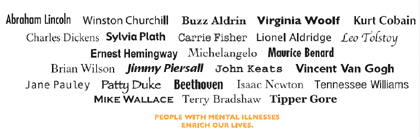
In The Company Of Greatness – Mental Health Awareness Month

Struggling with a mental illness can make life seem bleak.  It can be inspirational to learn that many of the world’s most famous people have had or currently have a mental illness.  This includes writers, entertainers, artists and political leaders.

  • Isaac Newton – He was the most famous mathematician of the 17th Century, and was responsible for many scientific discoveries we take for granted today. Such as the “corrected” Gregorian calendar date. Newton’s greatest mathematical discovery was the gravitational relationship between the earth and the moon, and of centrifugal force. Newton was well educated, had access to the best knowledge of his day, and was wealthy in later life. In 1705 Newton was the first Scientist to be  knighted by Queen Anne for his great scientific contributions. He suffered from several “nervous breakdowns” in his life and was known for great fits of rage towards anyone who disagreed with him. Some have have said that he had Bipolar Disorder, which was unknown at the time.
  • Linda Hamilton – Best known for her role in “Terminator”, Linda Hamilton  was diagnosed with bipolar late in life, and refers as the years from ages 20 to 40 as “her lost years”. Her rages and mood swings destroyed her marriages and, despite her considerable professional success, she describes her life before treatment as “bleak”.Linda Hamilton’s Interview with Larry King
  • Joe Nash– As a Nobel Prize Winner in mathematics, he has faced a lifelong battle with schizophrenia. He was known as the “Phantom of Fine Hall” at Princeton where his reclusive, ghost like figure could be seen roaming around, leaving messages of his mathematical genus on the boards of empty classrooms. His struggle was well documented in the book “A Beautiful Mind,” by Sylvia Nasar which was later made into a movie by the same name.
  • Ashley Judd – She once spent 47 days in a treatment facility for depression and other emotional problems.  She says
  • “It’s so simple really: I was unhappy and now I’m happy,” she says. “Now, even when I’m having a rough day, it’s better than my best day before treatment.”

  • Brooke Shields – She was diagnosed with Postpartum Depression.  She first had difficulty bonding with her baby and later thought of hurting it and even killing herself. She was able to gain a significant improvement in her mood through medication and the help of a skilled nurse-helper who recognized her problem and encouraged her to get help.

Next week I will highlight more famous people who live or lived with a mental illness.

Parents With Mental Illness – Mental Health Awareness

There is a stigma attached to parents who have a mental illness. This stigma is more severe than for any other chronic illness, like diabetes, heart disease, and cancer. Many people believe that all parents with a mental illness are incapable of being a good parent.  They assume that the children of these parents will be emotionally scarred, abused and neglected.  This is simply not true. Most parents with a mental illness, that is being properly managed,  are no different than parents without a mental illness.

With the wide variety of mental illnesses and symptoms, there will be some parents that find it difficult to be a “good parent”.  However, studies have shown there is an equal percentage of parents without a mental illness that have difficulty with parenting.

Several mental illnesses, depression for example, commonly manifest during a person’s prime parenting years (ages 30 to 44).  This can make us question our own parenting abilities and cause us to worry about whether we are a fit parent or not.  Especially, if we have limited knowledge on what living with a mental illness is like and we have our own mistaken beliefs about the mentally ill.

As parents with a disease, the best thing we can do is get help.  Proper treatment will help us get our symptoms under control, so we can be the best parent we can be.  It will show our children that there is no shame in seeking help for our mental illness.

Here are a few tips to encourage us as we learn to manage our disease and parent at the same time.

  • Recognize the illness and get treatment
  • Recognize that it is possible to have a mental illness and be a “good parent” at the same time.
  • Recognize that staying with your treatment plan is the best way to get better.

Research has shown that “breaking the silence” and discussing a parent’s mental illness, in an age appropriate manner, can help strengthen the family unit and its individual members.  This approach has been found to be helpful in keeping the children resilient and also channeling the worry and self doubt of the parent into more positive outlets.  Like strengthening the parent-child relationship.

Some tips for a parent with a mental illness are:

  • Pay attention to your parenting and make sure your illness does not disrupt your children’s lives.
  • Make sure that your children continue to go to school.
  • Encourage your children’s participation in outside activities (sports, church, and etc.).
  • Encourage their relationships with peers and important adults in their lives (grandparents, uncles, aunts)
  • Make sure your children understand that it is not their fault that their parent is ill and that they are receiving treatment to get better.
  • Be prepared to talk more than once.  It takes families and children time to understand what is going on.  They also may need to be reassured several times that you are getting help and are working hard to get better.

The Benefits Of Having A Mental Illness – Mental Health Awareness

One of the things I had to learn in an effort to manage my Clinical Depression, was to look for the positive in everything. This was so stinking hard in the beginning. It was so outside of my nature that I have had to practice long and hard to see that life does not have to be as serious as I always thought it had to be. With that attitude in mind, I thought I would list thirteen benefits of having a mental illness. If you think of something you would like to see added to the list, put it in the comment section and I will add it.

  1. My life goes according to my schedule most of the time. One of the things that used to stress me out so much was always having to be someplace on time.  Whether it was picking up kids, or getting the grocery shopping done at a decent time, or going on outings, it would all stress me out.  Now that I cannot drive very much because of how sleepy my depression medications make me, someone else is responsible for keeping the schedule  Also because of the sleepiness, I now have a really good reason for why I do not do mornings, and why I need at least one nap a day.
  2. I am much more thankful than I used to be. I have had to learn to rely on other people.  I have had to learn how to say “I need help with something.”  That has made me appreciate the people in my life much more than I used to.
  3. I have a voice! In the past I rarely said what I meant, and meant what I said.  I was always watching what I said, out of fear of angering someone, or offending someone, or even making my needs known above someone else’s.  Now that I have a voice, I say what I mean and I mean what I say.  I am direct and honest with people, and I make my needs known.  I offer my opinions and thoughts.  I still try to not offend people, but I do speak my mind.  It is very liberating to just talk and express myself without the constant worry about who might take what I said the wrong way.
  4. I have made personal connections. When Clinical Depression began to rule my life, I lost my friends.  Most of it was due to my behavior.  I was not a very nice person before my recovery process began.  Since I have been doing better and have been putting myself out into the internet world, I have met so many wonderful people.  They know that I have a mental illness and they do not care about that diagnosis one bit.  Those friendships mean a great deal to me.
  5. No. I remember when my daughter was little and she did not want to listen to the word no.  I had a little song I that I would sing, I believe Lunette the Clown from The Big Comfy Couch was the inspiration behind it.  The words were simple and the tune could be anything you wanted.  It went something like this.  “No means no, means no, means no, means no….”  In the past saying the word no was something I struggled with.  Often that meant I would take on more than I could handle, get over-whelmed and stressed out, and then everything would fall apart.  Now when I find that I am struggling with sticking to my no, I start singing my No song and let people know that I cannot take on anymore than I already have on my plate because I have a mental illness and if I were to get overwhelmed I would very likely have a melt down.
  6. The Mail. I know this is going to sound totally insane, but I used to obsess about the mail.  I was convinced that if anyone other than me checked the mail, then there would be something disastrous in the mailbox.  Once I realized that the mail was a huge source of my anxiety, I chose to no longer get the mail from the mailbox.  Not only do I not have the stress of the mail anymore, but my husband is now in charge of the bills.  Being too anxious to check the mail got rid of two sources of stress at the same time.
  7. I have learned to laugh. I used to be so serious all the time.  Not anymore.  I have learned that laughter feels good.  I laugh at myself, I laugh with others, I laugh when I am all by myself.  I laughed when I re-read what I wrote about my mail box anxiety.
  8. My life is simple. I keep things in my life simple now.  No long exaggerated lists of things to do, clothes to wear, or suppers to cook.  Keeping things simple, frees up my time to do other things.
  9. I take risks. I will take chances now that I never would have before.  I always liked everything very predictable. Nothing could spin me out of control faster than things not going according to my plan.  Having a mental illness has taught me that nothing can really be planned.  Once I start planning, then I start worrying, then I become obsessed with worrying and then….you get the picture.  Now, for the most part, my life does not go according to a plan.   I am stepping out my comfort zone and trying new things, like writing.
  10. I have a better perspective. I have learned to not sweat the little stuff.   Because of my depression, I cannot get bogged down by the little things.  It would be too easy for it to trigger a depressed episode.
  11. I am a better person than I used to be. I had my own very negative ideas about what people with mental illnesses were like.  Now I am one of those people and I have come to realize that people with mental illnesses are not anything like I thought they were.
  12. Helping Others. Being willing to talk about my illness helps others.  It lets them know they are not alone with their thoughts and feelings and there are things that can be done to feel better.
  13. I take better care of myself. I value my life and health much more than I used to.  I spend the time and energy necessary to monitor my other illnesses and do the things I am supposed to in order to manage them.

Mental Health Bloggerss – Mental Health Awareness

I originally started blogging as a way for me to do deal with my own out of control emotions. As I have grown, changed and become less depressed, I have kept blogging as a way to make people aware of what it is like to live with Clinical Depression, and an Anxiety Disorder, and how Diabetes and Asthma can affect Mental Health.

As I have traveled around the internet, seeing other blogs, I realized that there are many people who blog for the same reasons I do. To put their own Mental Health story out there, with the hope that it can benefit someone.

For today’s Mental Health Awareness post I wanted to take the time to list five of the ones I have found. Each one tackles Mental Health from a different perspective, and some have a different mental illness than I have. Next week I will list five more.

BPD in OKC This is one of the first bloggers I began following. This part of how she describes her blog and why she blogs:

    “My life feels like I am stuck riding on a rollercoaster in the middle of a hurricane. I have ups and downs, and I have left a path of destruction in my wake. My sanity dangles on a tiny fragile string, and through this blog I am giving the world a look into my broken mind and my unstable life.”

Our Journey Through Life I love this blog! The author tells her story from the perspective of what it is like living with a spouse who has Bi-Polar Disorder. Although, I do not have a Bi-Polar Disorder diagnosis, her site has been very educational for me. It has given me insight into how my own diagnosis affects my family.

Chato B. Stewart, Mental Health Humor
This site is probably one of the best I have found. Mr. Stewart approaches the issue of Mental Health from the humorous side. His tongue and cheek humor, exhibited through his cartoons, and caricatures, is a great reminder that even though we have a serious diagnosis, we do not always have to be so serious.

The Bi-Polar Spouse This is a new site to me, but I like what I have seen so far. This is a very detailed site about what it is like living with a spouse who has Bi-Polar Disorder, and tips and strategies to help maintain a healthy relationship with them.

Up and Down Time
Another site that is new to me, but one I like. It has great information and high lights in it. It is the blog for the Colorado Chapter for Depression and Bipolar Support Alliance (DBSA)