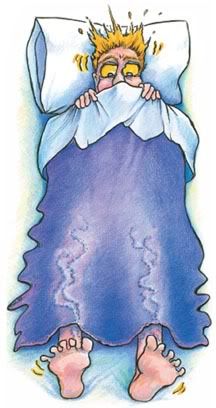
Letter To Dr. Rosenfeld of Fox News

I usually listen to Fox News on Sunday mornings. I say listen, because at the same time it is on my TV I am usually doing some thing else at the same time. On Sunday mornings, they have a feature called House Call. The basic idea of this feature is people write in with their questions, and Dr. Isadore Rosenfeld, M.D. takes the time to answer a few of them while he is on the Air.

Today, he responded to a question about the effectiveness of Quinine in the treatment of Rest Leg Syndrome (RLS). After he gave his opinion about the use of this medication, he went on and gave – what I considered to be – a soft pedaled description about RLS, and some ideas for what people could do to manage their symptoms.

What he said irked me. It was another expert playing down how much RLS symptoms can affect a person’s quality of life. It also just continued to add more to people’s – including doctors – misunderstanding.

I decided to write him a letter.


To: housecall@foxnews.com

Subject: Restless Leg Syndrome

Dear Dr. Rosenfeld,

Today I listened to your response to someone’s question about Restless Leg Syndrome, and the effectiveness of Quinine. After you addressed that question, you went on to speak about some suggestions of possible causes of restless leg syndrome and gave some ideas on how to alleviate the symptoms. While I am sure some or all of your suggestions work for some people, there is a significant portion of people with RLS whose symptoms are not alleviated by any of those things, and often not even with the current available medications.

In my family, my great-grandmother, and grandfather had RLS symptoms when they were alive. Currently, my mother, brother, and myself all have moderate to severe symptoms. My mother and I see the same doctor regarding our RLS – treating RLS is one of his specialties. He often says my mother’s RLS symptoms are the worst he has ever seen. For my age – as compared to the rest of the RLS patient population – my symptoms are fairly severe. My mother and I live in a constant state of sleep deprivation, and it has a huge, negative impact on our quality of life. There are many message boards on the internet where people discuss the impact that RLS has had on their life, and how horrible their existence is. Some of us with RLS can never escape from our symptoms.

The general public has a great deal of misunderstanding about how bad RLS can get. It is frustrating when I hear people talk about it as if it were not a big deal. I believe part of that misunderstanding comes from soft pedaled descriptions of RLS – like the one you offered today. When I hear experts talk about RLS, I really wish they would take a moment or two to inform the public about the “dark side” of RLS. It would be a great benefit. Not only would it help do away with the current misunderstanding about RLS, thereby creating a more accepting – believing – society, it might actually make it easier when we have to go to doctors who are not familiar with RLS. There is nothing like that feeling I get when people think I am not telling the truth about my RLS symptoms – including most doctors. It is an awful experience to have to explain repeatedly that you cannot take certain medications like Benadryl, Phenergan, Reglan, and many psychiatric medications because they exacerbate your symptoms and have them not believe you.

I really hope that consider what I have written, and take the time to investigate some of the RLS message boards out there. Here is a website that might help point you in the right direction if would like to learn more. We Move

I am not affiliated with the website, or organization in anyway. It just happens to be one of the best ones out there for offering factual and easy to read information about RLS – in my opinion.

Thank you,

Melissa Shell

Shhh – Mom Is Sleeping

My mom is actually sleeping. Before you say ” So what?”, I need to explain something to you. At the end of last week, mom went about four days with barely any sleep, and this week she has not experienced much of a change. The primary reason is Restless Leg Syndrome (RLS). Her legs have been making her more miserable than usual.


I have heard her crying, and moaning because of how miserable she is. There are days when she looks physically ill, because of how little sleep she has had. There is no doubt in my mind that the lack of sleep is detrimental to her health, and I am not sure if there is much more -if anything – that can be done to help her. She is suffering, and is attempting to cope as best as she can.


I usually, get up a few times every night. When I do, I try to locate mom –  just to check on her. That ritual is like playing a game of ” Where’s Waldo” – I never quite know where she is going to be when I start looking for her. This morning was no exception. This time I actually found her in a bed -snoring. That tells me that she was not only asleep, but that it was one of the few times she managed to fall deeply asleep.


Just because I found her sleeping does not mean she got a decent night’s rest. So – like I normally do – I tried to make as little noise is possible. I hope she is still asleep.


I wanted to share this with you, because I do not think most people realize how horrible RLS can make someone’s life. I believe Restless Leg Syndrome is an Invisible Illness whose detrimental effects on a person’s mind, and body have long been misunderstood.

The Reality Of RLS

There is a great deal of misunderstanding about Restless Leg Syndrome (RLS). Most people – including doctors – see it as “uncomfortable”, “inconvenient”, and “not a big deal”. I suppose for many people those adjectives are an accurate way to describe their symptoms. However, there is a rather large population of RLS patients whose daily – and nightly – lives are miserable. Even the definition of RLS does not accurately describe how much it can impact a person’s quality of life. According to the Mayo Clinic:

Restless legs syndrome (RLS) is a condition in which your legs feel extremely uncomfortable while you’re sitting or lying down. It makes you feel like getting up and moving around. When you do so, the unpleasant feeling of restless legs syndrome temporarily goes away.

Restless legs syndrome can begin at any age and generally worsens as you get older. Women are more likely than men to develop this condition. Restless legs syndrome can disrupt sleep — leading to daytime drowsiness — and make traveling difficult.

The reality for many – who have RLS – is so much worse than that description. Their lives are miserable – with symptoms that almost never go away, and never having enough sleep. The RLS symptoms alone can make it a depressing, and demoralizing existence. When you add in most people’s misunderstanding – including many doctors – about this disorder, patients often feel as if they are alone – with no support system.

In some cases, a patient may have such severe symptoms that – in addition to the usual RLS medications (i.e. Mirapex, Requip) – they are prescribed oxycodone, and methadone. Many physicians – not understanding the impact RLS can have on someone’s quality of life – who encounter patients who have been prescribed narcotics for their symptoms often rush to judgement, and are quick to voice their negative opinions about the use of such drugs in RLS treatment. In my opinion, this negative attitude  is the result of physicians not staying abreast of the latest information about RLS.

It is not just physicians who display a lack of compassion, and understanding. Most people – even those with milder forms of RLS – cannot fathom how destructive RLS can be to a person’s life. Some are quick to offer advice about “home remedies”, and alternative treatments – appearing to become judgmental when their advice is not taken. This can make the isolation that someone with RLS feels even more pronounced. Living life in a cloud of sleep deprivation wears on a person – negatively affecting their relationships, as well as their physical, and mental health.

Even with medications, many RLS sufferers still experience severe symptoms. This can have a huge negative impact on their quality of life, and mental health.  Many spend their nights – as well as their days – constantly on the move. They can never really relax, because the moment they do their symptoms become decidedly worse. This constant need to move – coupled with an extreme lack of sleep – can be extremely depressing. Many people with this disorder often reach a point – due to a lack of control over their symptoms, and the knowledge that they will only get worse – where they seriously consider suicide.

I have Restless Leg Syndrome. I would say that my symptoms are moderate. Most of the time the medication I take for it is able to control my symptoms. However, what many people – including doctors – do not realize is there are many medications that can make RLS symptoms significantly worse. Among those are many of the medications used to treat mental health issues/mental illness. The medication I currently take for my depression is one of those. If I do not take it very early in the day, I will experience RLS symptoms starting in the afternoon – continuing most of the night – that my RLS medication cannot get under control. Even as frustrated, and out of sorts as I get because of my RLS, I feel very blessed that my symptoms are not as severe as my mother’s – yet.

Since I have been staying with my parents, it has become extremely apparent to me how awful RLS has made my mother’s life. She literally can never relax, put her feet up, and just hang out. Sometimes it is even impossible for her to sit, and have a meal with me, and my father. Over the last few months she has had horrible problems with her legs – severe problems with one of her knees, and extremely horrible circulation. The doctors she sees for both issues recommend that she spend a lot of time with her legs elevated. For most people this would be something fairly simple to do. Not for my mother. Due to her RLS, she cannot spend nearly enough time with her legs elevated. She spends a lot of time standing, and walking around on her swollen, and pain filled legs.

She almost never has enough sleep. I have seen her so sleep deprived that she has fallen asleep while standing- holding onto her walker.  In the past – before she had to use the walker – she had several very bad falls. I think they could have been caused by her dozing off while walking and/or standing. There are some nights when her symptoms are so bad they cause her to cry – more like wailing – out of frustration, and misery. On more than one occasion my mother has said that RLS has affected the quality of her life “more than having cancer ever did”.

Even with all I have written here to describe the miserable reality of an RLS sufferer, it is still inadequate. I do not believe there are enough words to really explain what life can be life for someone with Restless Leg Syndrome. I do hope what I have written brings a measure of understanding about how RLS can affect the mental health of people with this disorder.


Wouldn't Want To Be In Her Shoes

My mom lives her life constantly sleep deprived. Her severe Restless Leg Syndrome symptoms are so severe – even with multiple medications – that she rarely gets an appropriate amount of sleep. There are many days when I literally see her sleeping “on her feet”, with her body propped up against one of the kitchen counters. Recently, her lack of sleep, and dozing off problem became worse due to an unexplained injury to one of her knees. Some how she has developed a torn meniscus, a crack in the bone, bruising in the bone, and significant swelling in the bone. Her orthopedist has ordered her to stay off of her feet for at least four weeks – she does not listen well, currently she is shopping.

In an effort to help her stay off of her feet, my dad and I have been trying to take her food, drinks, and etc. when she needs it. Sometimes we put her drinks in a special no spill cup she has  – think of a coffee mug thing with a self locking lid. It helps keep the messes down when she dozes off with her drink in her hand. Unfortunately, she also dozes off when she has a plate of food in her hands.

My mother has a special area set off for her to read, and have quiet time in. She has several chairs in there that are comfortable for her to sit in. The other night she was in her area and I took her supper to her. She had taken some pain medication so she was dozing off more than usual. Everything seemed to be going okay – until she called me over. Once I got there, she said, “I cleared my plate.” I really thought that was an odd thing for my mother to say. Then she hands me her house shoe…it seems she had a little “accident” with her plate – most likely when she dozed off.

I Hate Restless Leg Syndrome

Restless leg syndrome (RLS) is a neurological condition that causes someone to have an irresistible urge to move their legs (In some cases their arms as well).  Despite the fact that some people, including doctors, do not acknowledge it as a real condition, it is.

In my family we have what is called Primary RLS.  Basically that means the people in my family have RLS that is not caused by an injury or a medication.  The people in my family that we know for sure have it or had it are my great-grandmother, my grandfather, my mother, my brother, possibly my son, myself, and my daughter has started exhibiting some symptoms.

Some symptoms of RLS are:

  • A strong urge (for me it is a horrible and irresistible urge) to move your legs (for some people it can include their arms).  The need to move your legs is often accompanied by extremely uncomfortable sensations, like feeling as if there are bugs crawling around in your legs, feeling as if you are being stuck with pins and needles (much different than having your foot fall asleep feeling),  pulling, tugging or and/or gnawing.
  • The symptoms are usually worse at night or when you are resting.  Some people find that they have symptoms when they are required to sit for long periods, like in a car. Symptoms are usually worse the more sleepy you are.
  • Your RLS symptoms get better with movement.  Either they go away for a short period of time or they are reduced. The relief usually begins shortly after your legs (or arms) become active, and will usually last the duration of the activity.

RLS can make it so you have an extremely difficult time falling asleep and/or staying asleep.  Lack of sleep is one of the chief complaints by people with this disorder. The lack of sleep caused by this disorder can have a huge negative impact on your physical and mental health.

When my RLS symptoms are out of control, it really affects my mental health, as well as my sleep and how I feel physically.  Just the symptoms alone are enough to affect my mental health because they feel so bad.  In fact, the final thing that pushed me into the act of suicide was the thought that since my husband and I had lost our health insurance I would not be able to obtain the medication I need to keep my symptoms controlled.

To me, the misunderstanding about how badly RLS can affect someone can be equated to the misunderstanding about people with mental health issues.  It is a horrible disorder than eats away at your life.  For me and my family, it is nothing like it is portrayed in the TV commercials where it is only slightly annoying.  My mother has probably not had a good night’s sleep in years because her symptoms are so bad. Her medications for it do not alleviate all of her symptoms.  I am caught in a catch 22 type of situation.  The medications I need to treat my depression make the symptoms worse, which means I have had to increase my dose of RLS medication twice in the last year.  My brother sometimes gets symptoms in his arms as well as his usual ones in his legs.

People who have Primary RLS cannot look forward to a time when their symptoms might go away, like people whose RLS is solely caused by a medication or injury can.  Instead, our symptoms almost always get worse as we get older.  Because so few doctors really understand how insidious this illness can be, they are often at a loss on how to treat us.  Often for us to get any relief from our symptoms, we have to take a higher dose of the RLS medications than is normally given out, and this tends to make most doctors a little wary about prescribing those higher doses.

I hate RLS with a passion.  I hate how it makes my arms and legs feel.  I hate how it takes away my sleep.  I hate how I see it affecting my mother.  I hate the fact that my children most likely have it.  I hate how it turns the simple act of taking a nap into a huge deal.  I hate that it often keeps me and my husband from sleeping in the same bed.